ScienceTechnical Deep Dive

Beyond the Laser: The Rise of Electromechanical Corneal Reshaping

Published
EElectricBuzz Editorial Team
Beyond the Laser: The Rise of Electromechanical Corneal Reshaping
3 min read533 wordsElectricBuzz Editorial Team

The Gist

“A pioneering new research study suggests that the future of vision correction may involve gentle electrical stimulation rather than invasive laser surgery.”

The Shift Away from Surgical Ablation

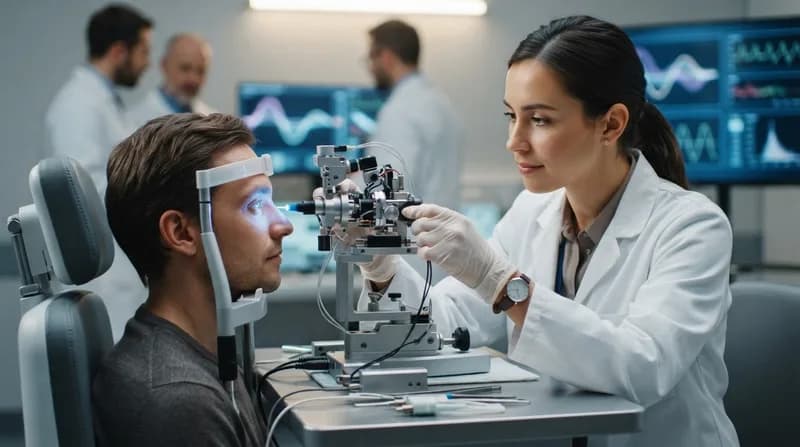
For decades, LASIK has stood as the gold standard for permanent vision correction, yet the procedure carries the inherent drawback of being invasive. By using lasers to physically carve away corneal tissue, surgeons essentially alter the eye's anatomy permanently. Now, a team of researchers is exploring an alternative method known as Electromechanical Reshaping (EMR), which aims to correct refractive errors without a single incision or a single pulse of a surgical laser.

Led by a collaborative team from Occidental College and the University of California, Irvine, this experimental approach treats the cornea not as a rigid structure to be carved, but as a malleable material. By utilizing the intrinsic chemical properties of the eye's collagen-rich tissue, the team is developing a process that allows the cornea to be softened, molded, and set into a new, corrective shape in approximately one minute.

The Chemistry of Corneal Molding

The cornea is composed largely of collagen, a structural protein held together by a network of electrical attractions between charged particles. These structural bonds maintain the eye's shape, which determines how light is focused onto the retina. The EMR technique takes advantage of these bonds by applying a precise electric potential to the corneal tissue, effectively altering its local pH levels.

By lowering the pH, the acidity within the tissue temporarily weakens the electrical interactions between collagen fibers. During this brief window of flexibility, the cornea becomes soft enough to be reshaped. Researchers use a specialized platinum contact lens that acts as both a mold and an electrode to guide the cornea into the desired curvature. Once the electric potential is removed and the tissue's pH returns to normal, the collagen bonds re-establish themselves, locking the cornea into its new, optimized refractive shape.

Why it Matters: A Potential Paradigm Shift

The implications of this research are significant for the field of ophthalmology. Unlike LASIK, which involves the permanent removal of tissue, EMR is theoretically non-invasive and offers the possibility of being reversible. This could reduce the risks associated with corrective procedures and provide a much more accessible alternative for patients seeking relief from myopia and other refractive errors.

  • Non-Invasive: Eliminates the need for incisions or laser-based tissue ablation.
  • Efficiency: The reshaping process is achieved in roughly one minute, making it comparable in speed to current laser procedures.
  • Cost-Effective: The equipment required for EMR is potentially much simpler and cheaper to manufacture than current, complex laser platforms.
  • Versatility: Preliminary tests suggest the technology might even treat corneal cloudiness, opening doors for therapeutic applications beyond simple vision correction.

The Path Toward Clinical Reality

While the initial results—tested on rabbit eyeballs—have shown high success in correcting simulated nearsightedness while keeping corneal cells intact, the researchers are quick to caution that the technology is still in its infancy. The "long march" of development now requires rigorous testing in living models to ensure long-term stability and safety. The team is currently navigating the complexities of securing funding and designing detailed protocols for future animal studies. If these subsequent trials prove successful, EMR could eventually transform from a laboratory curiosity into a standard, accessible, and potentially reversible solution for millions of people worldwide struggling with their vision.


SPONSORED
The 5 Best Over-Ear ANC Headphones of 2026, Tested & Ranked
Editor's Pick Guide
92/100
Tech & Gadgets•12 min read

The 5 Best Over-Ear ANC Headphones of 2026, Tested & Ranked

We locked five over-ear ANC picks for 2026 — Sony WH-1000XM6, Bose QuietComfort Ultra 2, Soundcore Space One, Sennheiser Momentum 5, and Apple AirPods Max 2 — then stress-tested them on lab metrics, long-term owner truth, and live street prices.

Related Stories

Semantically matched articles, ranked by topic overlap and freshness.

Florida's Record-Breaking Dengue Outbreak Signals New Public Health Reality
Science

Florida's Record-Breaking Dengue Outbreak Signals New Public Health Reality

As Tampa grapples with the largest locally acquired dengue outbreak in the continental U.S. in decades, experts point to a shifting climate and evolving migration patterns as the catalysts for this 'new normal.'

Eyes on Emotion: How Attention Patterns Predict Childhood Depression Risk
Science

Eyes on Emotion: How Attention Patterns Predict Childhood Depression Risk

A new study using eye-tracking technology reveals that children at risk for depression exhibit distinct, observable patterns in how they perceive and process emotional facial expressions.

GLP-1 Receptor Agonists Linked to Increased Anesthesia Risks
Science

GLP-1 Receptor Agonists Linked to Increased Anesthesia Risks

A major new study reveals that patients taking GLP-1 receptor agonists face a significantly higher risk of pulmonary aspiration during surgical procedures.

Could Mulberry Extracts Be the Future of Metabolic Health?
Science

Could Mulberry Extracts Be the Future of Metabolic Health?

A promising new study from Wroclaw Medical University explores how specific compounds in mulberry plants may reshape gut bacteria to boost metabolic function.

A Breakthrough in Pediatric Health: European Consortium Validates Type 1 Diabetes Screening
Science

A Breakthrough in Pediatric Health: European Consortium Validates Type 1 Diabetes Screening

A landmark multi-country study confirms that population-wide screening for early-stage Type 1 Diabetes in children is both feasible and highly effective.

A 245-Million-Year-Old Snapshot: Fossil Reveals Earliest Known Reptilian Digestive System
Science

A 245-Million-Year-Old Snapshot: Fossil Reveals Earliest Known Reptilian Digestive System

Paleontologists have uncovered an exceptionally preserved Triassic marine reptile that defies evolutionary expectations by keeping its internal organs intact for over two centuries of millions of years.

Acoustic Predators: New Study Reveals Sharks Pinpoint Sounds from 250 Feet Away
Science

Acoustic Predators: New Study Reveals Sharks Pinpoint Sounds from 250 Feet Away

Groundbreaking research from Florida Atlantic University proves blacktip sharks can detect and navigate away from low-frequency sounds at significant distances, revealing a sophisticated sensory world beneath the waves.

Global Life Expectancy Rebounds: WHO Reports Near Pre-Pandemic Levels
Science

Global Life Expectancy Rebounds: WHO Reports Near Pre-Pandemic Levels

A new WHO report reveals that while global life expectancy has nearly recovered to 2019 levels, the quality of healthy life years remains a critical challenge for global health systems.