An Epic Journey to the Sun's Doorstep
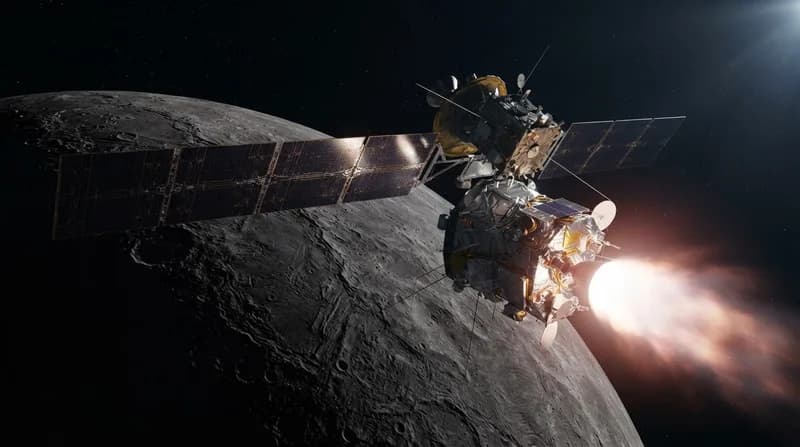
After a grueling, multi-year trek through the inner solar system, the BepiColombo spacecraft has officially reached its destination: the orbit of Mercury. A collaborative triumph between the European Space Agency (ESA) and the Japan Aerospace Exploration Agency (JAXA), the mission represents one of humanity's most complex navigational challenges. Because Mercury is caught in the Sun's immense gravitational well and features a notoriously fast orbit, the spacecraft had to execute a series of gravity-assist flybys past Earth, Venus, and Mercury itself to shed enough velocity to be captured by the planet.
This arrival follows a previously adjusted timeline. In 2024, the team faced thruster underperformance that necessitated a major trajectory redesign, shifting the arrival from mid-2025 to the present. While mission control confirmed the craft successfully entered orbit this past weekend, they simultaneously disclosed that the critical insertion burn was truncated due to a software anomaly. Currently, the spacecraft remains stable, and engineers are working to diagnose the root cause of the unexpected early shutdown.
The Scientific Mission Objectives
The core objective of BepiColombo is to deploy two specialized orbiters to conduct a comprehensive study of the planet. The ESA’s Mercury Planetary Orbiter (MPO) is tasked with high-resolution surface mapping, analyzing the planet’s internal composition, and conducting precise measurements of the magnetic field. A critical component of the MPO’s mission is the use of onboard instruments to test Einstein’s theory of General Relativity with unprecedented precision.
Complementing this is JAXA’s Mercury Magnetospheric Orbiter (MIO), which will focus on the environment surrounding the planet. This includes studying the magnetic field dynamics, plasma interactions, dust distribution, and the composition of the thin mercurial atmosphere. Together, these orbiters are designed to withstand extreme thermal environments—some of which are ten times more intense than what is encountered in Earth's orbit—using advanced thermal protection systems like layered titanium and Nextel ceramic fabrics.
Why It Matters
The successful arrival of BepiColombo is a significant milestone in planetary science. Despite only two prior missions, Mariner 10 and Messenger, having visited Mercury, our understanding of the planet remains limited. BepiColombo represents the third and most advanced effort to understand how the innermost planet of our solar system formed and evolved. The mission's ability to operate under the harsh conditions of the Sun’s proximity pushes the boundaries of space engineering, providing a blueprint for future high-temperature missions.
Status and Outlook
- Current Status: Orbit secured; teams are currently investigating the software error that shortened the final thruster burn.
- Deployment Timeline: Full science operations are slated to commence in April 2027.
- Technical Resilience: The MPO utilizes 94kg of specialized heat-insulating blankets to protect its sensitive instrumentation from the scorching surface radiation of Mercury.
While the software complication is a setback, the mission's long-term goals remain intact. As the agencies prepare for the 2027 start date, the scientific community looks forward to the data that will undoubtedly provide new insights into the formation of our solar system's innermost neighbor.