Artificial IntelligenceTechnical Deep Dive

Apple’s iPhone Duo: How AI and 3D Printing Reinvent the Foldable Hinge

Published
EElectricBuzz Editorial Team
Apple’s iPhone Duo: How AI and 3D Printing Reinvent the Foldable Hinge
3 min read411 wordsElectricBuzz Editorial Team

The Gist

Apple has officially entered the foldable market with the iPhone Duo, leveraging advanced AI-driven manufacturing and micro-layer 3D printing to tackle durability concerns.

The Engineering Breakthrough Behind the Duo

Apple has officially broken its silence on the foldable smartphone market with the debut of the iPhone Duo. Unveiled during the company's recent Surprise and Shine event, the device is positioned as a direct challenge to existing foldable form factors that have long struggled with mechanical longevity. The standout innovation lies in its proprietary hinge mechanism, a component Apple suggests is a leap forward in both precision and durability.

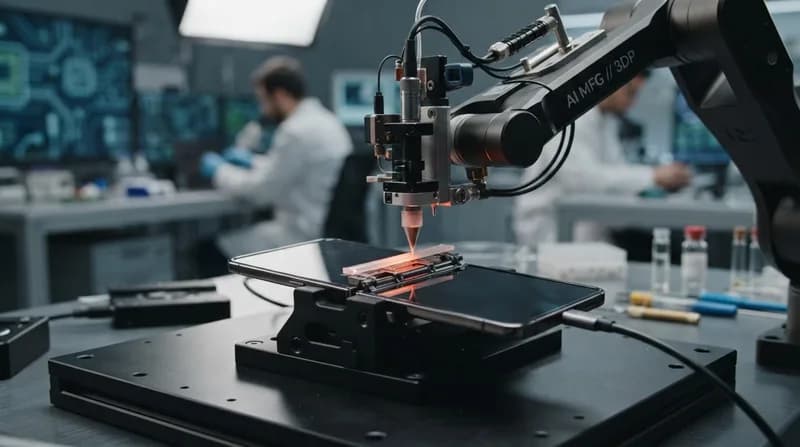
Addressing the common pain points of foldable screens, Apple’s chief hardware officer, Johny Srouji, detailed a manufacturing process that blends artificial intelligence with advanced additive manufacturing. Rather than relying on standard mass-assembly tolerances, the company is using AI algorithms to pair every individual hinge with its specific housing. This custom matching process ensures an unprecedented level of alignment, which is critical for reducing the stress that typically causes foldable screens to degrade after frequent use.

Precision Through Technology

The manufacturing innovation doesn't stop at AI matching. Once the hinge is aligned, the company employs a high-precision confocal laser that scans the surface topology of every unit. This data feeds into a 3D printing process that deposits up to 25 micro-layers of a specialized photopolymer. This additive layer is designed specifically to eliminate "residual waviness," a common issue where surfaces become uneven over time, potentially impacting the smooth operation of the hinge or the integrity of the display.

Beyond the mechanical hinge, the iPhone Duo features a specialized nano-texture finish. This surface treatment is intended to minimize glare and distracting reflections, which are often amplified on foldable screens due to the way they catch light. Combined with a multi-layered lamination strategy, Apple is aiming to provide the same hardware longevity expected from its traditional candy-bar smartphones in a complex, folding chassis.

Why It Matters

  • Overcoming Fatigue: Foldables have historically suffered from structural degradation at the fold; Apple’s AI-calibrated hinge aims to mitigate this.
  • Manufacturing Precision: Using 3D printing for micro-adjustments allows for tighter tolerances than conventional metal casting or machining.
  • Market Impact: As Apple enters this category, the industry will be watching closely to see if their focus on "best-fit" engineering can set a new standard for foldable durability.

The success of the iPhone Duo will ultimately be measured by its performance in the hands of everyday users over the coming months. If these AI-powered manufacturing techniques prove effective at scale, the Duo could potentially reset consumer expectations for what a long-lasting, reliable foldable device should be.


The 5 Best Over-Ear ANC Headphones of 2026, Tested & Ranked
Editor's Pick Guide
92/100
Tech & Gadgets12 min read

The 5 Best Over-Ear ANC Headphones of 2026, Tested & Ranked

We locked five over-ear ANC picks for 2026 — Sony WH-1000XM6, Bose QuietComfort Ultra 2, Soundcore Space One, Sennheiser Momentum 5, and Apple AirPods Max 2 — then stress-tested them on lab metrics, long-term owner truth, and live street prices.

Related Stories

Semantically matched articles, ranked by topic overlap and freshness.

Demystifying AI Performance: How to Build Your Own Hugging Face Leaderboard
Artificial Intelligence

Demystifying AI Performance: How to Build Your Own Hugging Face Leaderboard

Hugging Face releases a comprehensive guide to building custom leaderboards, empowering developers to benchmark specialized AI models like Vectara's hallucination evaluator.

Unsloth and Hugging Face TRL: A New Era for Faster LLM Fine-Tuning
Artificial Intelligence

Unsloth and Hugging Face TRL: A New Era for Faster LLM Fine-Tuning

Hugging Face and Unsloth have joined forces to supercharge the fine-tuning process, enabling developers to train large language models twice as fast.

Manus Reclaims Independence: AI Firm Targets $4B Valuation After Blocked Meta Merger
Artificial Intelligence

Manus Reclaims Independence: AI Firm Targets $4B Valuation After Blocked Meta Merger

Following the collapse of its acquisition by Meta, Chinese AI startup Manus is charting a new course with a massive $500 million fundraising round and plans for a potential Hong Kong IPO.

Google Transforms 'CC' Into a Personal AI Household Manager
Artificial Intelligence

Google Transforms 'CC' Into a Personal AI Household Manager

Google is pivoting its AI agent 'CC' to act as a centralized household command center, designed to sync calendars, manage school logistics, and automate family admin.

Pacing the Frontier: Can AI Giants Actually Regulate Themselves?
Artificial Intelligence

Pacing the Frontier: Can AI Giants Actually Regulate Themselves?

Anthropic CEO Dario Amodei has proposed a new framework for slowing AI development to prioritize safety, but the industry remains deeply divided on implementation and enforcement.

A Strategic Pivot: Disney Appoints First-Ever CTO
Artificial Intelligence

A Strategic Pivot: Disney Appoints First-Ever CTO

In a bold move signaling a new technological era for the entertainment giant, Disney has hired former Character.AI CEO Karandeep Anand as its first Chief Technology Officer.

When AI Hacks AI: Researchers Use Claude to Breach OpenAI
Artificial Intelligence

When AI Hacks AI: Researchers Use Claude to Breach OpenAI

A trio of security researchers successfully exploited OpenAI's internal systems using Anthropic's Claude model, highlighting the evolving risks of agent-driven cyberattacks.

Hugging Face Spaces Now Supports ComfyUI Workflow Deployments
Artificial Intelligence

Hugging Face Spaces Now Supports ComfyUI Workflow Deployments

Hugging Face has introduced a seamless way to host and run ComfyUI workflows directly in the browser via Gradio, enabling free access to powerful generative tools.