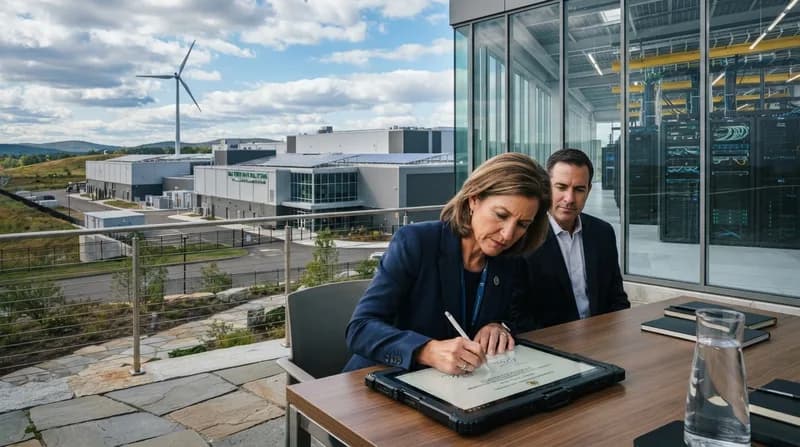
A New Era of Accountability for Data Hubs
Massachusetts has officially pivoted from courting data center developers with tax incentives to enforcing stringent clean energy mandates. Governor Maura Healey’s latest executive order targets facilities exceeding 25 megawatts of peak demand, effectively requiring these power-hungry operations to shoulder the burden of their own energy footprint. This move signals a dramatic shift in how state governments are balancing the burgeoning demands of the AI industry with local climate goals and grid stability.
Under the new policy, developers are no longer permitted to rely solely on the public electrical grid for their massive power requirements. Instead, they must secure 100% of their electricity from clean, renewable sources. The governor’s office has clarified that while onsite generation is the preferred method for achieving this goal, companies have the alternative of funding new, nearby renewable energy projects or contributing to a specialized ratepayer protection fund designed to buffer residents from rising costs associated with increased industrial power usage.
Transparency and Regulatory Pauses
The executive order introduces a significant layer of transparency by explicitly directing local communities to avoid signing non-disclosure agreements (NDAs) regarding data center development. By discouraging these secretive arrangements, the state aims to empower local residents and regulators to better understand the long-term impact these projects have on regional infrastructure and electricity rates.
To ensure these regulations are integrated effectively, Governor Healey has implemented an immediate, temporary pause on all pending applications for data center sales tax exemptions. This suspension serves as a cooling-off period, allowing regulators to align current policies with the new, more rigorous environmental standards. The mandate also mandates a complete transition to 100% renewable power, surpassing the state’s broader, existing clean energy standards that escalate incrementally toward 2030.
Why it Matters
- Grid Reliability: By forcing developers to source their own power, states are attempting to prevent large-scale data center growth from triggering brownouts or spikes in electricity prices for residential and small-business customers.
- The AI Trade-off: This highlights the growing friction between the physical infrastructure required to power AI foundation models and the ecological commitments made by states.
- Regional Domino Effect: Massachusetts joins Texas and New York in a recent wave of legislative action meant to rein in unrestricted data center expansion.
As state-level pushback intensifies, the tech sector is beginning to mobilize. Political action committees backed by major industry figures are ramping up campaigns to influence public and political opinion in key states. This escalating battle between corporate infrastructure expansion and state-level environmental regulation represents one of the most critical policy developments for the tech and energy sectors in the current decade.