A Half-Century of Exploration in Martian Days
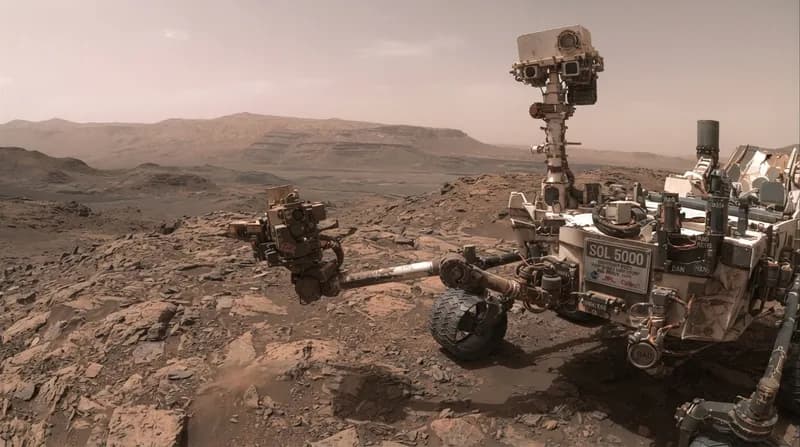
NASA's Curiosity rover has officially surpassed 5,000 Martian days—or "sols"—on the surface of the Red Planet. This remarkable longevity milestone was reached in late September 2026, solidifying the rover's legacy as one of the most productive robotic explorers in the history of space science. Currently positioned at a sandy ridge aptly named "Chocolatal," the rover took a moment to document its surroundings, providing a rare and visually striking perspective of the Gale Crater landscape.
To celebrate the event, the mission team utilized Curiosity’s navigation cameras to capture high-resolution imagery. Because these onboard cameras typically record in black and white, the team employed an artistic technique to bring the data to life. By combining two distinct panoramas—one taken in the early morning and another in the late afternoon—engineers synthesized a "postcard" that highlights the dramatic changes in Martian light and shadow. The resulting composite uses blue hues to signify the morning session and vibrant yellow tones for the evening, creating a high-contrast view that emphasizes the rugged terrain the rover has navigated for years.
Hardware and Mission Context
The new image provides more than just aesthetic value; it serves as a detailed snapshot of the rover's current physical state. Observers can clearly identify key components in the foreground, such as the cylindrical UHF antenna responsible for transmitting data to orbiters high above the surface. Also prominent is the Multi-Mission Radioisotope Thermoelectric Generator (MMRTG), the nuclear power source that has sustained the rover’s operations long after its primary mission window closed. Stretching away from the rover, deep ruts in the Martian soil serve as a literal trail of the rover's scientific journey.
Currently, Curiosity is situated at the foothills of Mount Sharp, a massive geological formation rising three miles (five kilometers) from the floor of the crater. The panorama captures the downward slope toward the crater floor, with the distant crater rim visible along the horizon. This location is strategically important, as the layers of Mount Sharp contain critical evidence regarding the planet's transition from a potentially habitable, water-rich environment to the arid, cold desert observed today.
Why It Matters
- Mission Longevity: Surpassing 5,000 sols demonstrates the exceptional engineering durability of the JPL-built hardware in an extremely hostile environment.
- Geological Insights: Curiosity’s continued exploration of Mount Sharp provides essential data on Martian paleoclimate and the history of liquid water on the planet.
- Evolutionary Adaptability: Beyond its original mission parameters, the rover has received multiple software updates throughout its life, allowing it to perform more complex, autonomous scientific tasks.
- Data Relay Network: The imagery emphasizes the reliance on Martian orbiters for long-distance data transmission, a crucial component for all current and future surface exploration missions.
Outlook: Beyond the Milestone
Looking ahead, the mission shows no signs of slowing down. Having mastered the art of multitasking through iterative software improvements, the rover remains the primary tool for studying the lower geological strata of the Gale Crater. As it continues its climb, the data harvested by Curiosity will continue to be instrumental in training researchers and refining the autonomy protocols necessary for future crewed missions to Mars. The 5,000-sol mark is not just a celebration of past survival, but a testament to the ongoing technical prowess powering the next generation of solar system exploration.