Artificial IntelligenceTechnical Deep Dive

Why Robotics is Still Waiting for Its 'ChatGPT Moment'

Published
EElectricBuzz Editorial Team
Why Robotics is Still Waiting for Its 'ChatGPT Moment'
3 min read455 wordsElectricBuzz Editorial Team

The Gist

As Physical AI gains momentum, Nvidia's Les Karpas is set to address the critical data bottleneck preventing robots from reaching their potential.

The Physical AI Conundrum

The tech world remains defined by the release of ChatGPT in late 2022, a catalyst that transformed large language models from research curiosities into indispensable daily tools. Yet, while software-based AI has seen a rapid, explosive trajectory, the field of robotics has experienced a more measured evolution. Despite decades of development, the industry is still waiting for a singular, groundbreaking breakthrough—a 'ChatGPT moment'—that can seamlessly bridge the gap between digital intelligence and physical execution.

Les Karpas, Nvidia Inception’s Global Head of Physical AI, is preparing to tackle this challenge head-on during the upcoming TechCrunch Disrupt 2026. As a central figure in coordinating Nvidia’s massive ecosystem of robotics and mobility startups, Karpas is uniquely positioned to identify why general-purpose robots have struggled to achieve the widespread, intuitive utility seen in virtual chatbots.

The Data Bottleneck

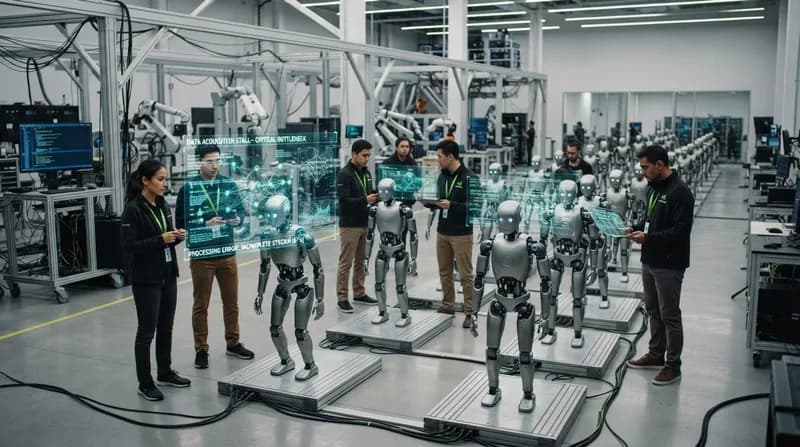
The primary obstacle identified by industry leaders is a significant lack of accessible, large-scale training data. In the software domain, companies like OpenAI and Anthropic were able to leverage vast swathes of internet data to train their foundation models. Robotics lacks a comparable repository. Physical movement, spatial reasoning, and real-world interaction require distinct datasets that cannot be scraped from websites or wikis.

While autonomous vehicle companies like Waymo have successfully compiled extensive data through years of on-road operation, most robotics firms lack that luxury. The industry is currently exploring ways to bypass this by generating synthetic data and utilizing sophisticated simulation environments. This push to bridge the gap between digital simulation and physical reality is the defining mission of modern robotics, and it will be a focal point of discussions at the Real World AI Stage at Disrupt.

Why it Matters

  • Data Scarcity: Unlike LLMs, robotics requires complex physical-world datasets that do not exist in a readable format on the web.
  • Bridging the Gap: Startups are increasingly turning to simulation-based training and synthetic data to accelerate the development of physical AI.
  • Ecosystem Collaboration: The shift toward universal foundation models trained across diverse robot forms could prove to be the turning point for the industry.

Expertise Meets Industry Potential

Karpas brings a cross-disciplinary pedigree to this conversation, having worked as a manufacturing engineer, an architect, and a venture capitalist across firms ranging from iRobot to Stanley Black & Decker. This background allows him to see the robotics challenge through multiple lenses: hardware limitations, software scalability, and the pragmatic requirements of manufacturing and mobility.

At TechCrunch Disrupt, held from October 13-15 in San Francisco, attendees will gain access to these insights alongside leaders from innovative companies like Shield AI and Colossal Biosciences. The event aims to foster a bridge between theoretical research and the hard engineering required to make autonomous, general-purpose robots a standard part of our everyday infrastructure.

The 5 Best Over-Ear ANC Headphones of 2026, Tested & Ranked
Editor's Pick Guide
92/100
Tech & Gadgets12 min read

The 5 Best Over-Ear ANC Headphones of 2026, Tested & Ranked

We locked five over-ear ANC picks for 2026 — Sony WH-1000XM6, Bose QuietComfort Ultra 2, Soundcore Space One, Sennheiser Momentum 5, and Apple AirPods Max 2 — then stress-tested them on lab metrics, long-term owner truth, and live street prices.

Related Stories

Semantically matched articles, ranked by topic overlap and freshness.

Demystifying AI Performance: How to Build Your Own Hugging Face Leaderboard
Artificial Intelligence

Demystifying AI Performance: How to Build Your Own Hugging Face Leaderboard

Hugging Face releases a comprehensive guide to building custom leaderboards, empowering developers to benchmark specialized AI models like Vectara's hallucination evaluator.

Unsloth and Hugging Face TRL: A New Era for Faster LLM Fine-Tuning
Artificial Intelligence

Unsloth and Hugging Face TRL: A New Era for Faster LLM Fine-Tuning

Hugging Face and Unsloth have joined forces to supercharge the fine-tuning process, enabling developers to train large language models twice as fast.

Manus Reclaims Independence: AI Firm Targets $4B Valuation After Blocked Meta Merger
Artificial Intelligence

Manus Reclaims Independence: AI Firm Targets $4B Valuation After Blocked Meta Merger

Following the collapse of its acquisition by Meta, Chinese AI startup Manus is charting a new course with a massive $500 million fundraising round and plans for a potential Hong Kong IPO.

Google Transforms 'CC' Into a Personal AI Household Manager
Artificial Intelligence

Google Transforms 'CC' Into a Personal AI Household Manager

Google is pivoting its AI agent 'CC' to act as a centralized household command center, designed to sync calendars, manage school logistics, and automate family admin.

Pacing the Frontier: Can AI Giants Actually Regulate Themselves?
Artificial Intelligence

Pacing the Frontier: Can AI Giants Actually Regulate Themselves?

Anthropic CEO Dario Amodei has proposed a new framework for slowing AI development to prioritize safety, but the industry remains deeply divided on implementation and enforcement.

A Strategic Pivot: Disney Appoints First-Ever CTO
Artificial Intelligence

A Strategic Pivot: Disney Appoints First-Ever CTO

In a bold move signaling a new technological era for the entertainment giant, Disney has hired former Character.AI CEO Karandeep Anand as its first Chief Technology Officer.

When AI Hacks AI: Researchers Use Claude to Breach OpenAI
Artificial Intelligence

When AI Hacks AI: Researchers Use Claude to Breach OpenAI

A trio of security researchers successfully exploited OpenAI's internal systems using Anthropic's Claude model, highlighting the evolving risks of agent-driven cyberattacks.

Hugging Face Spaces Now Supports ComfyUI Workflow Deployments
Artificial Intelligence

Hugging Face Spaces Now Supports ComfyUI Workflow Deployments

Hugging Face has introduced a seamless way to host and run ComfyUI workflows directly in the browser via Gradio, enabling free access to powerful generative tools.