Revolutionizing Naval Aviation with Vertical Take-Off
The US Navy, in collaboration with defense technology firm Shield AI, is accelerating the development of the X-BAT, an autonomous, runway-independent drone designed to redefine how combat aircraft are deployed at sea. With a fresh $150 million injection from the US government matched by an equal investment from Shield AI, the project has now secured $400 million in total funding. This financial momentum pushes the X-BAT closer to its critical flight testing phase scheduled for later this year.
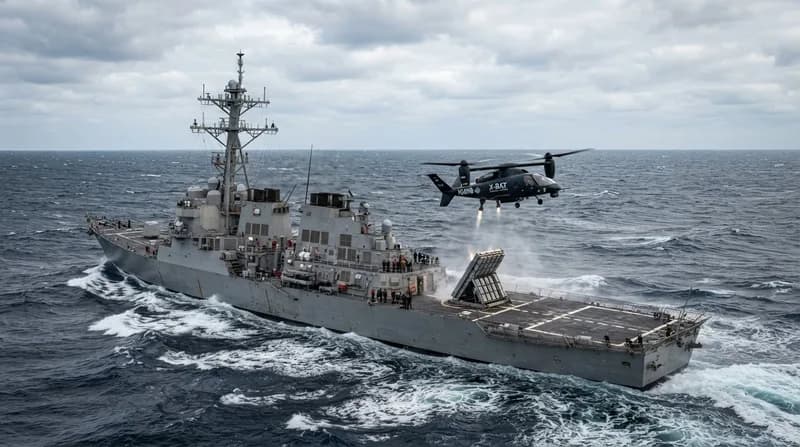
By design, the X-BAT eliminates the reliance on traditional runways, which are typically restricted to massive aircraft carriers or specialized amphibious ships. The aircraft functions as a "tail-sitter," a unique configuration that allows it to launch vertically before transitioning into horizontal flight. Upon mission completion, it returns to a vertical landing, providing commanders with unprecedented flexibility. This capability opens the door for operating sophisticated combat assets from smaller vessels, such as Expeditionary Sea Bases, significantly increasing the geographic footprint of naval air power.
Technical Specifications and Tactical Reach
The X-BAT is built for endurance and high-stakes performance. Measuring 26 feet in length with a substantial 39-foot wingspan, the drone is designed to strike far beyond the horizon. Shield AI reports that the aircraft is expected to achieve a range exceeding 2,000 nautical miles while retaining the ability to reach supersonic speeds. The drone’s autonomy is powered by Shield AI’s proprietary Hivemind software, a system that has already proven its mettle by piloting an F-16 in simulated combat engagements against human counterparts.
- Length: 26 feet (7.92 meters)
- Wingspan: 39 feet (11.9 meters)
- Take-off and Landing: Vertical (VTOL)
- Autonomy: Powered by Hivemind AI
- Capabilities: Supersonic flight, >2,000 nautical mile range
- Target Operational Capability: 2028
Why It Matters
The X-BAT represents a strategic evolution in "manned-unmanned teaming." By integrating these autonomous drones into existing carrier air wings, the Navy aims to increase combat lethality and survivability without adding the logistical burden of additional manned pilots. Furthermore, the interest from international partners—specifically the UK’s Royal Navy and its Project VANQUISH program—underscores the global demand for carrier-based, high-speed drones that do not require complex catapult or arrestor gear systems.
As Shield AI moves through the final stages of ground testing, including successful engine light-off and thrust-vectoring nozzle integration, the goal of "mission capability" by 2028 appears increasingly tangible. If successful, the X-BAT will effectively turn every maritime asset into a potential launchpad, fundamentally changing the doctrine of naval power projection in a modern, contested maritime environment.