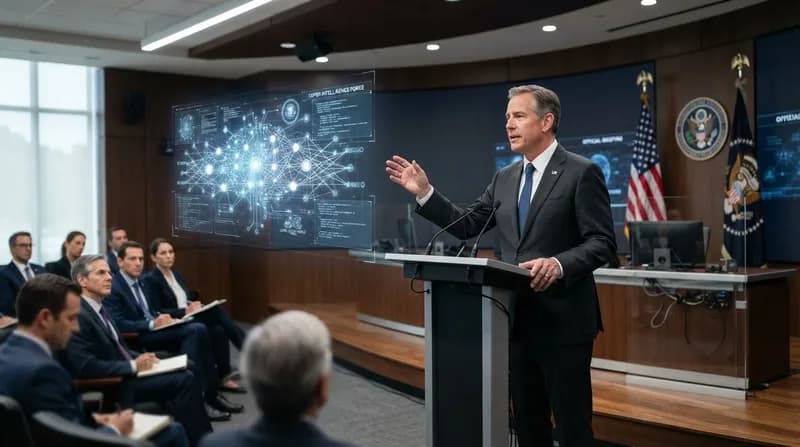
The Emergence of the Super Intelligence Force
President Donald Trump has formally announced the establishment of the 'Super Intelligence Force,' a high-level government task force dedicated to ensuring that the United States maintains a decisive edge in the rapidly evolving landscape of advanced artificial intelligence. The administration, which has moved to rebrand the technology as 'super intelligence' through recent executive orders, aims to leverage this new body to coordinate federal efforts and steer national policy on the development, deployment, and security of AI systems.
The announcement follows months of rhetoric surrounding the necessity of U.S. leadership in AI, with the President positioning the technology as a pivotal global force that eclipses previous milestones like the Industrial Revolution. By forming this task force, the administration intends to foster a regulatory environment that promotes rapid innovation and competitive growth while mitigating the risks posed by emerging AI-driven threats.
Leadership and Mandate
The newly formed task force will be led by National Intelligence Director Jay Clayton, who serves as the primary architect of this initiative. He will be supported by a group of key administration figures acting as vice chairs, including FTC Chair Andrew Ferguson, Undersecretary of War for Research and Engineering Emil Michael, and OPM Director Scott Kupor. This cross-departmental structure signals a broad government mandate that spans intelligence, military research, and federal trade oversight.
The primary charter for the Super Intelligence Force is to deliver a comprehensive report within 120 days. This document is expected to outline the specific risks and opportunities that super intelligence presents to the American public and the global economy. A central focus for the leadership team is the tension between maintaining technological dominance and avoiding what they describe as stifling overregulation. Jay Clayton has emphasized that falling behind global competitors, particularly China, is considered one of the greatest potential risks to national stability.
Why It Matters
- Strategic Redefinition: The rebranding of AI to 'super intelligence' reflects a shift in administrative focus toward framing the technology as a critical national asset.
- Deadline-Driven Governance: With a 120-day window to produce a findings report, the task force is under pressure to establish concrete policy frameworks quickly.
- Innovation vs. Regulation: The group’s stated mission to 'prevent overregulation' suggests a deregulation-heavy approach to AI development, aiming to keep the U.S. market attractive for massive scale-ups and private sector investment.
- National Security Focus: By integrating the Undersecretary of War for Research and Engineering into the vice-chair roles, the administration is clearly aligning AI advancement with long-term national security and defense interests.
As the task force begins its work, the tech industry is watching closely. The interplay between these government officials and the private sector will be crucial in determining how the United States approaches the ethical, safety, and economic complexities of the coming decade of artificial intelligence.