Bridging the Gap Between Research and Production
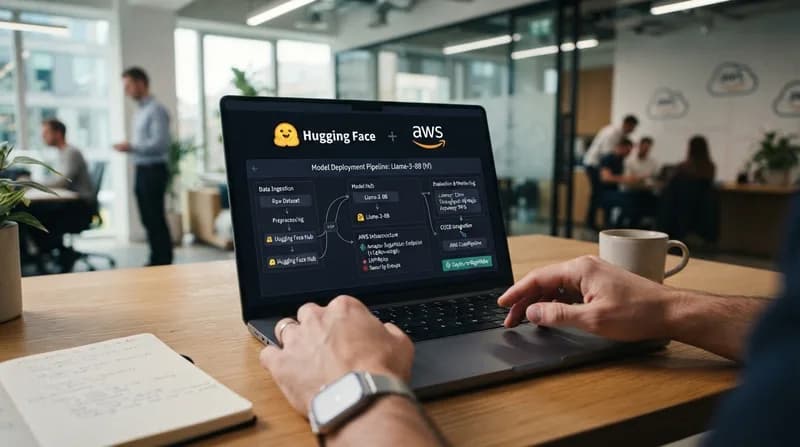
Hugging Face has officially rolled out its dedicated Large Language Model (LLM) inference container for Amazon SageMaker, a strategic move designed to dismantle the barriers often faced by developers when moving generative AI projects from experimentation to production. This new offering provides a highly optimized environment, specifically engineered to host some of the world's most powerful open-source models with minimal configuration overhead.
The container utilizes advanced optimization techniques to ensure that models—such as the 20-billion parameter EleutherAI GPT-NeoX—run with peak efficiency. By integrating directly into the Amazon SageMaker ecosystem, developers can now leverage managed infrastructure that handles model partitioning, batching, and high-performance inference acceleration without needing to manually manage complex GPU clusters.
Why It Matters
- Reduced Latency: By using optimized inference backends, the container significantly reduces the time-to-first-token for complex text generation tasks.
- Scalability: Built-in support for Amazon SageMaker’s auto-scaling allows applications to adjust resources dynamically based on real-time traffic demand.
- Seamless Integration: It leverages the familiar Hugging Face `transformers` library, allowing teams to swap models with minimal code changes.
This initiative represents a pivotal shift toward democratization in the AI space. By providing the plumbing necessary to run massive models at scale, Hugging Face is enabling startups and enterprise developers alike to deploy sophisticated generative AI features. Whether the goal is building a custom chatbot, an automated coding assistant, or a nuanced summarization tool, this container effectively offloads the heavy lifting of infrastructure management to AWS, letting engineers focus on model performance and application logic. With support for high-parameter models and continuous updates, this integration sets a new standard for how modern AI architectures are deployed in the cloud.