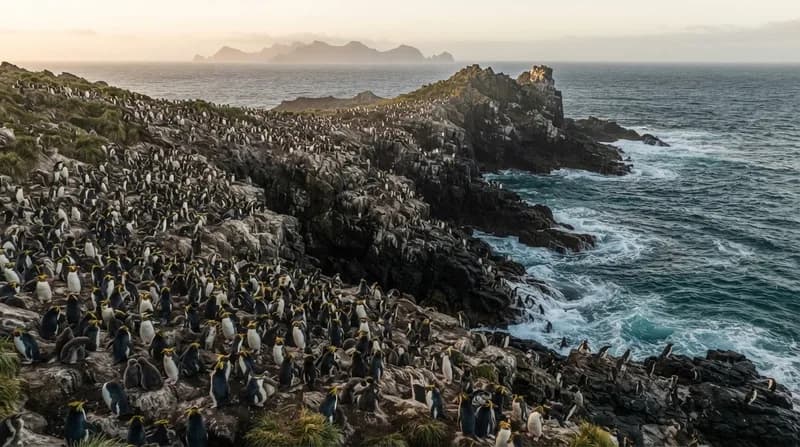
A Tale of Two Island Groups
In a discovery that has sent ripples through the marine biology community, researchers from the University of Otago have identified a striking divergence in the survival rates of the endangered Erect-crested penguin. While the species was previously viewed as a single, uniform population, new, high-precision drone surveys conducted between 2022 and 2024 have revealed that these birds are experiencing two vastly different realities depending on which island group they call home.
The study, published in PLOS ONE, focused on the Bounty and Antipodes islands, both remote outposts located 800 kilometers southeast of New Zealand. The findings shattered long-held assumptions: the tiny Bounty Islands, measuring only 50 hectares, support nearly 27,800 breeding pairs—an extraordinary density compared to the significantly larger Antipodes Islands, which host approximately 29,800 pairs despite being 40 times the size.
The Divergent Paths of Survival
The population trends for these two groups are as stark as their size differences. Historical comparisons dating back to the mid-1990s show that the Bounty Islands population has remained remarkably stable for over 25 years. Conversely, the Antipodes Islands have suffered a staggering decline of more than 40 percent in that same timeframe. This suggests that environmental factors unique to the Antipodes are exerting significant pressure on the colony.
Researchers point to several overlapping catalysts for this decline. The Antipodes Islands have seen increased pressure from native skuas, which prey on eggs and chicks. As colony numbers dwindle, the birds lose the safety-in-numbers advantage that typically deters these predators. This pressure was likely exacerbated by the historical collapse of Eastern Rockhopper penguin populations, which may have forced skuas to shift their predatory focus onto the Erect-crested penguins.
Environmental and Conservation Implications
Beyond predation, climate-driven events are taking a toll. Severe storms have caused landslides on the Antipodes, physically disrupting nesting colonies. Furthermore, the two populations exhibit distinct migratory patterns. Antipodes-based penguins travel deeper into the Antarctic Polar Frontal Zone after breeding, while Bounty-based birds remain in more sheltered, nutrient-rich waters near their nesting grounds. This behavioral split leaves the Antipodes group uniquely exposed to shifting ocean conditions.
The researchers have dubbed this phenomenon "Schrödinger’s Penguin." Much like the famous physics thought experiment, the condition of the species seemed to exist in two states—stable and declining—until the metaphorical "box" of population data was opened via these comprehensive drone surveys. The team warns that lumping these populations into a single global threat assessment could be dangerous. By averaging the numbers, the overall status might be misclassified as 'Vulnerable,' which would mask the rapid decline on the Antipodes and potentially strip away necessary protections for the remaining stable colonies on the Bounty Islands.