Tech & GadgetsTechnical Deep Dive

The AI Infrastructure Crunch: Why Trillions in Spending May Outpace Returns

Published
EElectricBuzz Editorial Team
The AI Infrastructure Crunch: Why Trillions in Spending May Outpace Returns
3 min read522 wordsElectricBuzz Editorial Team

The Gist

“A sobering new report from Gartner suggests that the massive capital pouring into AI datacenters may struggle to generate sufficient revenue, pointing toward a significant industry shake-out by 2030.”

The Coming Disconnect in AI Economics

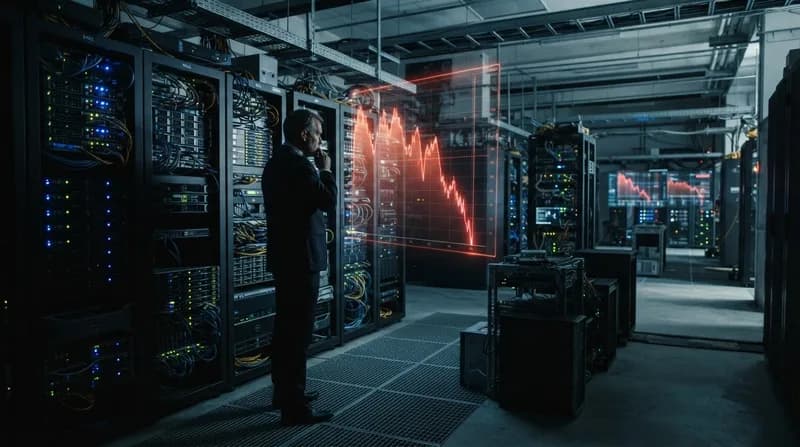
The tech industry is currently caught in a massive wave of capital expenditure, with companies racing to build out the infrastructure required to power the next generation of artificial intelligence. However, a stark new report from Gartner titled Prepare for AI Market Consolidation: Capital Write-Downs Could Exceed $4 Trillion by 2032 warns that the math simply isn't adding up. The analysis suggests that the projected revenue from AI-driven consumer and enterprise applications is nowhere near enough to cover the staggering costs of building and maintaining global AI datacenters through the end of the decade.

According to Gartner senior director analyst Will Sommer, the industry is projected to spend roughly $1 trillion on AI infrastructure in 2026 alone, with an additional $6 trillion expected to be poured into the sector between 2027 and 2030. To achieve a standard 12 percent return on invested capital (ROIC)—the threshold many firms use to define a profitable project—operators would theoretically need to generate $8.5 trillion in total revenue. Currently, the market trajectory suggests total AI-attributable revenue will reach only $3.6 trillion by that time, leaving a massive financial gap that threatens the viability of many players in the space.

The Neocloud Crisis and Market Consolidation

The report paints a particularly grim picture for "neocloud" operators—niche providers that specialize in "GPU-as-a-service" and AI compute. Because these companies lack the broad business diversification of massive hyperscalers like Amazon, Microsoft, or Google, they are uniquely vulnerable to the coming market correction. Gartner forecasts that 80 percent of these independent neocloud providers may not survive beyond 2030 as they face pressure from capital write-downs and the rapid obsolescence of expensive GPU hardware.

The financial markets are beginning to register this unease. Lending institutions and investment firms are showing signs of hesitation as the "AI upgrade treadmill" becomes more expensive to maintain. With concerns from organizations like the International Monetary Fund and the Bank for International Settlements regarding a potential AI bubble, the pressure is on for companies to prove that their massive infrastructure bets can translate into tangible, high-margin revenue rather than just experimental compute power.

Why it Matters

  • Capital Efficiency: The gap between the $7 trillion in planned spending and the $3.6 trillion in projected revenue suggests that "build it and they will come" is no longer a viable strategy for AI infrastructure.
  • Market Shake-out: Industry experts anticipate that smaller, specialized GPU providers will be forced to merge, be acquired, or exit the market entirely as they fail to compete with hyperscalers.
  • Economic Ripple Effects: Financial watchdogs are concerned that if the AI sector hits a wall, the negative impacts could ripple into the wider global economy, impacting borrowing costs and investment stability.

For the AI industry to sustain its current level of growth, it must move beyond simply expanding capacity. Experts from firms like Bain & Company suggest that the industry must identify and deploy high-value use cases that justify these monumental costs. Without a shift toward more profitable applications that can weather competitive pressure from open-source and international alternatives, the infrastructure boom may face a forced, painful correction in the coming years.

SPONSORED
The 5 Best Over-Ear ANC Headphones of 2026, Tested & Ranked
Editor's Pick Guide
92/100
Tech & Gadgets•12 min read

The 5 Best Over-Ear ANC Headphones of 2026, Tested & Ranked

We locked five over-ear ANC picks for 2026 — Sony WH-1000XM6, Bose QuietComfort Ultra 2, Soundcore Space One, Sennheiser Momentum 5, and Apple AirPods Max 2 — then stress-tested them on lab metrics, long-term owner truth, and live street prices.

Related Stories

Semantically matched articles, ranked by topic overlap and freshness.

The Brutal Rise of 'Doxx-to-Extort': How Ransomware is Turning Physical
Tech & Gadgets

The Brutal Rise of 'Doxx-to-Extort': How Ransomware is Turning Physical

A harrowing new industry report reveals that ransomware gangs are increasingly moving beyond digital encryption, using stalking, swatting, and physical threats against employees to force extortion payments.

China’s Strategic Pivot to Humanoid Dexterity
Tech & Gadgets

China’s Strategic Pivot to Humanoid Dexterity

China is aggressively prioritizing the development of advanced robotic hands, aiming to bolster its manufacturing dominance amidst shifting demographic trends.

Apple’s ‘Minions’ Project Turns Idle Macs Into a Massive AI Powerhouse
Tech & Gadgets

Apple’s ‘Minions’ Project Turns Idle Macs Into a Massive AI Powerhouse

Apple is revolutionizing internal compute efficiency by transforming idle Mac hardware into a distributed, high-performance GPU cloud for AI inference tasks.

The Invisible Tax: Why OpenAI’s 'Dot' Agent is Quietly Burning Through Your Token Budget
Tech & Gadgets

The Invisible Tax: Why OpenAI’s 'Dot' Agent is Quietly Burning Through Your Token Budget

New research into OpenAI’s 'Dot' personal assistant reveals that the agent functions with a high degree of autonomy, spinning up background processes that consume significant token volume without a single user prompt.

NetBSD Finds Unexpected Growth as a Haven for AI-Free Software Development
Tech & Gadgets

NetBSD Finds Unexpected Growth as a Haven for AI-Free Software Development

While the mainstream Linux ecosystem embraces AI-driven workflows, NetBSD is seeing a surge in support and donations by doubling down on its commitment to human-written code.

The $100 Billion Space Economy: How SpaceX’s IPO Is Transforming Orbit
Tech & Gadgets

The $100 Billion Space Economy: How SpaceX’s IPO Is Transforming Orbit

The aerospace sector has reached a monumental milestone as public market momentum and surging demand drive annual investment toward $100 billion.

Microsoft Reveals Azure Maia 300: A Multi-Gigawatt Ambition for Agentic AI
Tech & Gadgets

Microsoft Reveals Azure Maia 300: A Multi-Gigawatt Ambition for Agentic AI

Microsoft is scaling up its custom silicon strategy with the Maia 300, a high-performance accelerator system designed to dominate the next era of long-context AI inference.

TFG London Joins Growing List of Retailers Hit by Cyberattacks
Tech & Gadgets

TFG London Joins Growing List of Retailers Hit by Cyberattacks

Major retail group TFG London, owner of Hobbs, Phase Eight, and Whistles, confirms a significant cybersecurity incident disrupting its IT infrastructure and customer orders.