The SetFit Advantage
SetFit has rapidly become a go-to framework for the AI development community, particularly for developers grappling with the perennial problem of insufficient labeled data. By enabling efficient few-shot fine-tuning of Sentence Transformers, SetFit allows models to achieve high accuracy using only a handful of examples. Unlike Large Language Model (LLM) approaches that rely on complex, brittle prompt engineering, SetFit generates rich embeddings directly from text samples, making it faster to train and more reliable in production environments. With over 100,000 monthly downloads and a growing ecosystem on the Hugging Face Hub, the framework is a staple for modern natural language processing tasks.
Accelerating Throughput with Optimum Intel
While SetFit is already efficient, the challenge of production-grade deployment remains a priority for enterprise teams. A new collaboration between Hugging Face and Intel Labs offers a powerful solution: utilizing the 🤗 Optimum Intel library to optimize SetFit models for Intel Xeon processors. By applying post-training static quantization (PTQ), developers can significantly reduce model latency and increase throughput while maintaining high accuracy levels.
Optimum Intel leverages advanced hardware acceleration features found in Intel CPUs, including Advanced Vector Extensions 512 (AVX-512), Vector Neural Network Instructions (VNNI), and Advanced Matrix Extensions (AMX). These hardware hooks enable deep learning workloads to run with greater efficiency by using BFloat16 and INT8 GEMM accelerators embedded directly into each core.
The Quantization Workflow
The process of optimizing a SetFit model is designed for simplicity. It involves using the Intel Neural Compressor (INC) to convert high-precision weights into lower-bit representations like INT8. This reduction in precision is the engine behind the performance gains, as it decreases the memory footprint and accelerates computation.
- Calibration: Developers need to prepare a small calibration dataset—typically around 100 representative samples—to ensure the model maintains its accuracy during the quantization process.
- Implementation: Using the
INCQuantizermodule within Optimum Intel, the model undergoes static quantization tailored for NLP tasks. This process is "post-training," meaning no additional retraining or complex fine-tuning is required. - Deployment: The resulting model is a lighter, faster version of the original, ready to be deployed on standard Intel Xeon hardware without the need for specialized accelerators.
Benchmarking the Results
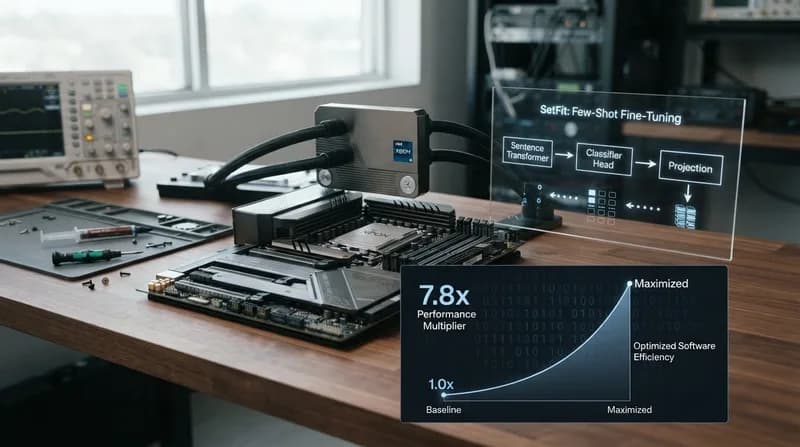
The performance gains achieved through this optimization are substantial. When tested against standard PyTorch and Transformers implementations (fp32), the quantized Optimum Intel model demonstrates a dramatic reduction in both size and latency. At a batch size of one, the optimized model showed a 3.45x improvement in latency. More importantly, when testing for maximum throughput across various batch sizes, the optimized model achieved a 7.8x speedup compared to the original baseline. Remarkably, these gains were achieved with virtually no loss in test set accuracy, proving that production teams can achieve significant cost savings and efficiency without compromising their model's intelligence.
Why It Matters
For organizations deploying NLP solutions at scale, the difference between a 1x and 7.8x throughput increase translates directly into server cost savings and improved user experience. By bridging the gap between high-performance AI research and existing enterprise server hardware like Intel Xeon, this optimization makes sophisticated AI more accessible for real-world production environments, removing the need for massive GPU clusters for inference tasks.