Artificial IntelligenceTechnical Deep Dive

Schneider Electric Reveals Blueprint for Greener, Less Water-Intensive AI Data Centers

Published
EElectricBuzz Editorial Team
Schneider Electric Reveals Blueprint for Greener, Less Water-Intensive AI Data Centers
3 min read463 wordsElectricBuzz Editorial Team

The Gist

New modeling from Schneider Electric suggests that shifting to higher-temperature liquid cooling could slash water consumption in massive AI server farms by over 50 percent.

The Shift Toward Liquid Cooling

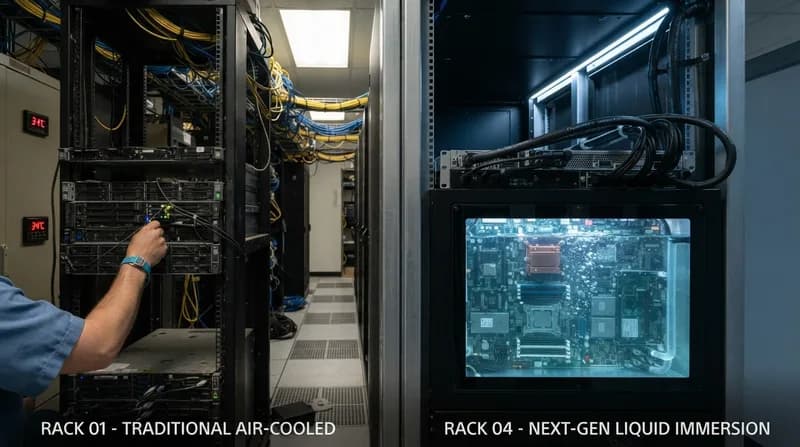
As artificial intelligence demands continue to drive a surge in high-density computing, data center operators are facing a dual crisis: ballooning power requirements and massive water consumption. Schneider Electric has released a comprehensive white paper, "Water Usage at AI Scale: Insights from a 100 MW Comparative Analysis," which argues that the architectural design of cooling systems is the single most significant factor in mitigating the environmental footprint of these facilities. By evaluating four distinct 100 MW design scenarios, the research suggests that liquid-cooled infrastructure, particularly when operated at higher coolant supply temperatures, is essential for sustainable growth.

The Role of Coolant Temperature

The core of Schneider’s analysis revolves around the thermal dynamics of the cooling loop. The firm compared traditional air-cooled setups against liquid-cooled designs using varying temperature set points. The findings indicate that raising the coolant supply temperature from a standard 32°C (90°F) to 45°C (113°F) creates a dramatic improvement in water efficiency. By operating at these higher temperatures, facilities can utilize 'free cooling'—relying on ambient outside air to reject heat—for a much larger portion of the year, effectively eliminating the need for energy-intensive mechanical chillers that rely on evaporative cooling processes.

Why it Matters

  • Water Scarcity: With data center water usage tripling over the last decade, public scrutiny of AI infrastructure is intensifying.
  • Capital Efficiency: Designing cooling systems specifically for a 45°C set point allows for leaner infrastructure, potentially reducing initial capital expenditure (CAPEX).
  • Strategic Siting: The model demonstrates that location is secondary to design; even in hot climates like Dallas, Texas, optimized liquid cooling can outperform traditional setups in water conservation.
  • Integrated Sustainability: The report emphasizes that power usage effectiveness (PUE) cannot be managed in a vacuum; operators must balance energy efficiency with water stress to ensure long-term viability.

Strategic Implications for Operators

Schneider Electric, which maintains a significant commercial stake in the cooling sector following its acquisition of Motivair, suggests that the industry must move away from the 'one-size-fits-all' approach to server cooling. The data clearly shows that cooling towers, while common, can consume up to 20 times more water than dry cooler alternatives. By transitioning to higher-temperature liquid systems, operators not only lower their utility bills but also significantly reduce their impact on local water supplies, easing the tension between AI development and municipal resource management.

Ultimately, the report serves as a roadmap for the next generation of data centers. As rack densities climb to support increasingly complex AI models, the thermal management of these racks will define the environmental profile of the tech industry. Schneider’s call to action is clear: sustainability must be baked into the design process from day one, prioritizing advanced cooling architectures that can handle the heat of the AI era without drying out the communities that host them.


The 5 Best Over-Ear ANC Headphones of 2026, Tested & Ranked
Editor's Pick Guide
92/100
Tech & Gadgets12 min read

The 5 Best Over-Ear ANC Headphones of 2026, Tested & Ranked

We locked five over-ear ANC picks for 2026 — Sony WH-1000XM6, Bose QuietComfort Ultra 2, Soundcore Space One, Sennheiser Momentum 5, and Apple AirPods Max 2 — then stress-tested them on lab metrics, long-term owner truth, and live street prices.

Related Stories

Semantically matched articles, ranked by topic overlap and freshness.

Hugging Face Integrates Enterprise Hub with AWS Marketplace
Artificial Intelligence

Hugging Face Integrates Enterprise Hub with AWS Marketplace

Hugging Face now allows organizations to manage their AI development subscriptions directly through AWS, simplifying billing and procurement for enterprise teams.

Tabby Aims to Make Small Business Accounting Invisible with AI
Artificial Intelligence

Tabby Aims to Make Small Business Accounting Invisible with AI

Former accountant Ahad Ali is looking to disrupt the traditional bookkeeping industry by replacing complex SaaS platforms with a fully automated, AI-driven financial interface.

Hugging Face Unveils Tokenizers v1: A Massive Leap in AI Processing Speed
Artificial Intelligence

Hugging Face Unveils Tokenizers v1: A Massive Leap in AI Processing Speed

Hugging Face has announced the release candidate for Tokenizers v1, a major performance overhaul designed to eliminate bottlenecks in machine learning pipelines.

Google Unveils the 'Googlebook': A Bold Leap into AI-Integrated Hardware
Artificial Intelligence

Google Unveils the 'Googlebook': A Bold Leap into AI-Integrated Hardware

Google is officially opening pre-orders for the Googlebook, an $899 laptop engineered to place Gemini AI at the center of the desktop computing experience.

Quantum Physics Meets AI: A New Era for LLM Pruning
Artificial Intelligence

Quantum Physics Meets AI: A New Era for LLM Pruning

Researchers are borrowing concepts from statistical mechanics to dramatically optimize Large Language Model efficiency through a novel block-pruning technique.

NASA Extends SpaceX Crew Dragon Contract as Orbital Uncertainty Looms
Artificial Intelligence

NASA Extends SpaceX Crew Dragon Contract as Orbital Uncertainty Looms

NASA has awarded SpaceX a nearly $1 billion contract modification to ensure consistent astronaut transport to the ISS through 2030.

Hugging Face Enhances Enterprise Hub with Regional Data Residency
Artificial Intelligence

Hugging Face Enhances Enterprise Hub with Regional Data Residency

Hugging Face is rolling out Storage Regions, allowing enterprise users to pin their AI models and datasets to specific geographic data centers for compliance and performance.

Scaling Intelligence: Hugging Face Simplifies Embedding Model Deployment
Artificial Intelligence

Scaling Intelligence: Hugging Face Simplifies Embedding Model Deployment

Hugging Face has streamlined the process of deploying powerful embedding models, making it easier than ever to integrate state-of-the-art vector representations into production workflows.