Revolutionizing Distributed Training
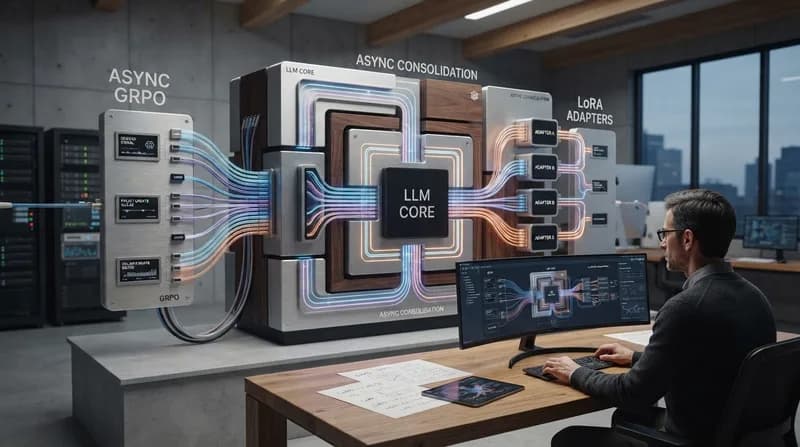
Hugging Face has unveiled a streamlined methodology for asynchronous Group Relative Policy Optimization (GRPO) combined with Low-Rank Adaptation (LoRA). By decoupling the generation and training phases, this architecture bypasses the complex requirements of NCCL (NVIDIA Collective Communications Library), making it significantly easier to scale model training across disparate compute resources.
Traditionally, training large language models requires tight synchronization between GPUs, often leading to bottlenecks if one node experiences a delay. This new approach shifts the paradigm by utilizing a central storage bucket for experience data and a proxy mechanism for model weight synchronization. This effectively isolates the throughput-heavy generation phase from the gradient-update phase, allowing developers to utilize heterogeneous infrastructure without the usual overhead of distributed orchestration.
Why It Matters
- Reduced Complexity: Removing the strict dependency on NCCL lowers the barrier for running massive reinforcement learning jobs on consumer-grade or non-uniform clusters.
- Resource Efficiency: Asynchronous updates ensure that compute units are not sitting idle while waiting for synchronization, maximizing total utilization across the training lifecycle.
- Flexibility: By integrating LoRA, the memory footprint is kept manageable, enabling fine-tuning of models like DeepSeek-R1-Distill-Qwen on more accessible hardware setups.
The implications for the open-source community are significant. As fine-tuning becomes a necessity for domain-specific reasoning, this framework democratizes access to RL-based training protocols. By allowing these workloads to run across standard job-queue architectures, teams can now scale their experiments without needing expensive, high-bandwidth interconnects that characterize traditional supercomputing setups.
As AI developers continue to push the boundaries of distilled models, this infrastructure update provides a scalable path forward. It represents a shift away from rigid, monolithic training environments toward flexible, resilient pipelines that prioritize developer velocity and hardware compatibility over micro-second synchronization.