Democratizing Large Language Models
The landscape of artificial intelligence has shifted dramatically with the rise of open-source large language models (LLMs). While proprietary solutions like ChatGPT have set the standard for performance, the emergence of models like Vicuna—an open-source chatbot with 13 billion parameters—is allowing developers and researchers to run sophisticated AI locally. Developed by a collaboration between UC Berkeley, CMU, Stanford, and UC San Diego, Vicuna is fine-tuned from the LLaMA base model using a massive dataset of 70,000 user-shared conversations. Impressively, it delivers performance that rivals top-tier proprietary models while remaining accessible for independent testing.
Historically, running such a massive model required high-end server-grade hardware, as a standard Vicuna-13B model in fp16 precision demands nearly 28GB of VRAM. However, through the use of post-training quantization, specifically the GPTQ (Generalized Post-Training Quantization) method, users can now condense these models into 4-bit precision. This significantly reduces the memory footprint while maintaining high accuracy, making the deployment of powerful AI on consumer-grade AMD hardware a reality.
Leveraging AMD ROCm for AI Inference
The bridge between raw AMD hardware and these advanced models is ROCm (Radeon Open Compute). As an open-source software platform, ROCm allows AMD GPUs to handle the heavy lifting required for deep learning tasks. By using ROCm, developers can run standard Pytorch workloads on compatible hardware, such as the Radeon RX 6900XT or the Instinct MI210 series, without needing specialized proprietary environments.
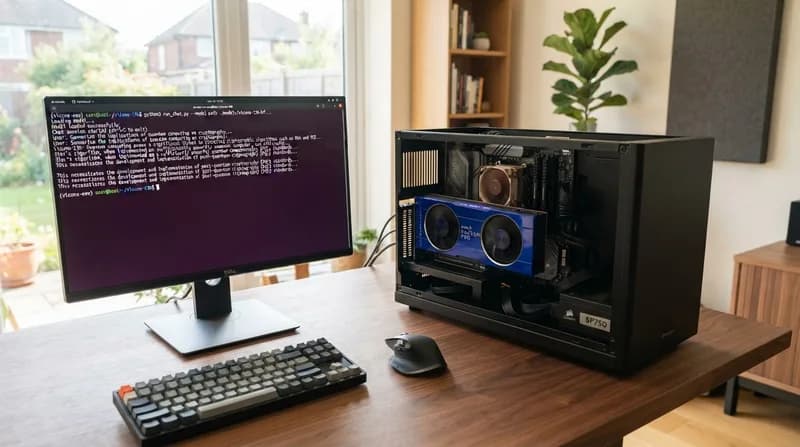
To get started, users must ensure their Linux-based environment is configured correctly, typically involving the installation of the ROCm stack via the official AMD package repositories. Using Docker containers pre-configured with ROCm and Pytorch 2.0 streamlines the process, ensuring that the necessary kernels for dequantization and matrix multiplication are properly linked to the hardware. This setup enables the 4-bit quantized version of Vicuna-13B to fit comfortably within the 16GB VRAM of a card like the RX 6900XT, consuming just under 8GB of memory for the model itself, leaving plenty of overhead for input and output caching.
Why This Matters
- Cost Efficiency: Running models locally eliminates the need for expensive API calls and recurring subscription costs for AI services.
- Memory Optimization: 4-bit GPTQ quantization reduces the memory requirements for the Vicuna-13B model by more than 70%, making it viable on high-end consumer GPUs.
- Hardware Versatility: The ROCm software stack continues to expand the ecosystem, allowing developers to utilize AMD's robust hardware for modern generative AI workflows.
- Data Privacy: By hosting the model locally, users retain full control over their inputs and the generated outputs, ideal for sensitive research or private creative projects.
Outlook and Implementation
The ability to run a 13-billion parameter model on a single consumer GPU marks a pivotal milestone for local AI deployment. Because LLM performance is often bottlenecked by memory bandwidth rather than pure compute throughput, quantized models do not suffer from severe latency penalties. Users can now expect efficient, responsive interactions for language translation, summarization, and content generation directly from their own workstations. As the ROCm ecosystem matures, we expect to see even further optimizations for model kernels, potentially lowering the barrier to entry for more complex and larger model architectures in the future.