The Automation of Quantum Discovery
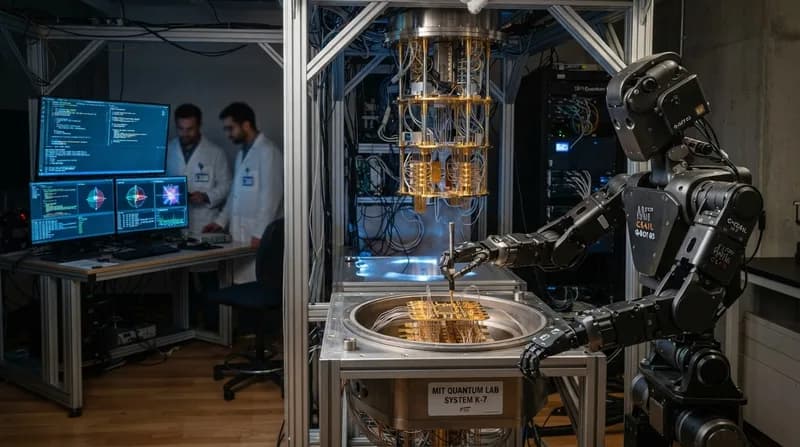
In a groundbreaking shift for experimental physics, researchers at MIT’s Engineering Quantum Systems Group (EQuS) have successfully integrated OpenAI's GPT-5.6 Sol into their laboratory workflows. By connecting this advanced AI model to specialized hardware control software, the team has enabled an AI agent to perform routine, time-consuming measurements on superconducting qubit chips without constant human oversight. This development allows graduate researchers to shift their focus away from the repetitive, manual calibration processes that have historically served as a bottleneck in quantum computing development.
Superconducting qubits, often described as artificial atoms, require extreme precision to operate. They must be cooled to near absolute zero in dilution refrigerators, where they are then manipulated through complex sequences of microwave pulses. Historically, characterizing these chips involves hundreds or thousands of interdependent measurements to identify resonance frequencies and decoherence times. Because qubit properties can drift due to environmental noise or physical imperfections, this process requires constant, tedious adjustment—a task now being offloaded to AI agents.
How the Integration Works
The system relies on the intersection of GPT-5.6 Sol and the Codex platform. By providing the AI with domain-specific skills—effectively teaching it how to interpret and act upon experimental data—the researchers allow the model to autonomously design measurement parameters. When the agent initiates a sequence, it reads the returning signals from the quantum chip, evaluates the data in real-time, and determines whether the current experiment was successful or if the parameters require fine-tuning.
During a successful run, the agent can map out a qubit's transition frequencies and calibrate the control pulses independently. This level of autonomy is particularly powerful for overnight experiments. Researchers can set the AI to work on routine chip characterization, allowing the lab to remain productive while they are away. The system also supports remote monitoring, where scientists can check the progress of their experiments via mobile devices and intervene only when necessary, effectively creating a 24/7 research cycle.
The Future of Human-AI Scientific Collaboration
While the AI shows remarkable promise, the EQuS team notes that it is not yet a total replacement for human intuition. In scenarios where experimental signals are noisy or ambiguous, GPT-5.6 Sol occasionally requires guidance from a human expert to interpret the findings. This highlights a critical, symbiotic dynamic: the AI acts as a tireless operator for well-defined, routine tasks, while the human researcher focuses on higher-level strategy, creative experiment design, and the interpretation of complex, novel anomalies.
Why it Matters
- Efficiency: Reduces the multi-day characterization process for new chips by automating repetitive data gathering.
- Scalability: Enables researchers to manage multiple experiments in parallel, with agents running various, narrower tasks simultaneously.
- Innovation: Shifts the researcher's daily load from manual data entry and hardware monitoring to high-level analysis and theoretical planning.
- Flexibility: The AI can be tasked not just with execution, but with writing, testing, and modifying the very code used to control the hardware, creating a closed-loop system for iterative discovery.
As the integration of AI agents into laboratory environments continues to mature, this model of human-AI collaboration suggests a new standard for scientific research. By offloading the "grunt work" of calibration and data collection, researchers are gaining the capacity to explore complex quantum phenomena at a speed that was previously impossible. The success at MIT proves that AI is no longer just a tool for generating text or code; it is becoming a vital, semi-autonomous partner in the physical laboratory.