Bridging the Gap Between Vision and Robotics
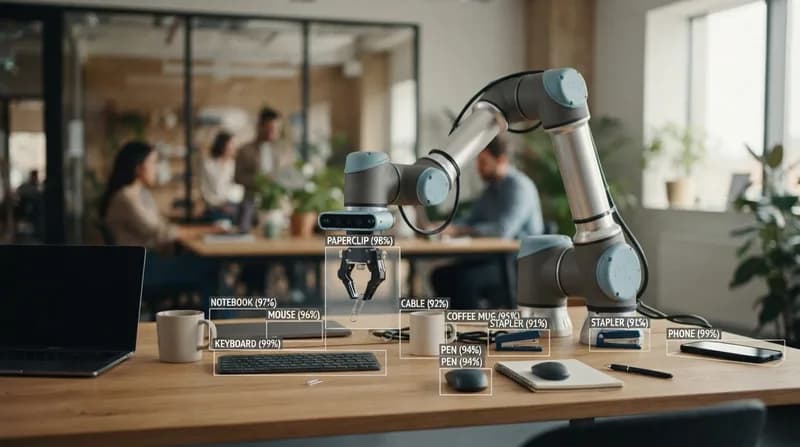
For robots to function effectively in dynamic, real-world environments, they require more than just pre-programmed movements; they need the ability to perceive and understand their surroundings. Pollen Robotics, the team behind the open-source humanoid robot Reachy, has taken a significant step toward solving this by launching pollen-vision. This new open-source library provides a unified interface for zero-shot vision models, effectively acting as the perceptual engine that allows robots to identify, locate, and interact with objects they have never seen before.
By utilizing zero-shot models, the library eliminates the need for tedious, task-specific training data. Developers can simply prompt the system with a text description, and the robot can attempt to locate the corresponding object in 3D space. This shift toward "out-of-the-box" intelligence is a vital evolution for robotics, where the ability to generalize across different environments determines the utility of a machine.
The Engine: Core Models of Pollen-Vision
The library is built upon three foundational models, chosen for their versatility and capability to run on standard consumer hardware. Each model plays a specific role in creating a robust 3D detection pipeline:
1. OWL-VIT (Open World Localization)
Developed by Google Research, OWL-VIT acts as the primary locator within the pollen-vision stack. It performs text-conditioned, zero-shot 2D object localization. When a user provides a text query, such as "paper cup," the model scans an RGB image and returns bounding boxes identifying the object's position, functioning similarly to traditional detection algorithms but with the added flexibility of natural language input.
2. Mobile SAM (Segment Anything Model)
To move beyond simple boxes, Pollen Robotics integrated a lightweight version of Meta AI’s Segment Anything Model. Once OWL-VIT identifies a region of interest, Mobile SAM generates precise segmentation masks. This level of granularity is crucial for robotics, as it allows the system to distinguish the object from its background, ensuring that depth calculations are based solely on the target object rather than surrounding noise.
3. RAM (Recognize Anything Model)
To optimize performance, the library includes OPPO Research Institute’s RAM model. Because OWL-VIT's inference time increases with the number of textual prompts, querying the system for every possible object is inefficient. RAM acts as a pre-processing filter, quickly determining which objects are actually present in the frame, allowing the pipeline to focus its computational resources only on relevant prompts.
Why it Matters
The core innovation of pollen-vision lies in its ability to synthesize these models into a functional 3D pipeline. By calculating the centroid of a segmentation mask and mapping it against camera depth data and intrinsic matrices, the library can translate a 2D pixel coordinate into a precise (x, y, z) location in the real world. This capability allows a robotic end-effector to move toward an object's spatial coordinates and attempt a grasp without prior calibration on that specific item.
While currently limited to basic spatial positioning—rather than full 6D pose estimation—this framework lays a foundation for more complex robotic manipulation. By providing a clean, modular API, Pollen Robotics is enabling researchers and developers to deploy sophisticated visual AI on robots with just a few lines of code, significantly lowering the barrier to entry for building autonomous physical agents.
Looking Ahead
Pollen Robotics has openly acknowledged that this initial release is a starting point. Current challenges, such as inconsistent object detection, lack of temporal consistency between frames, and the need for more advanced grasping techniques, remain active areas of development. Future updates are expected to include point-tracking solutions and improved methods for generating complex grasping poses, further expanding the library's utility in the field of autonomous manipulation.