Solving the Power Paradox
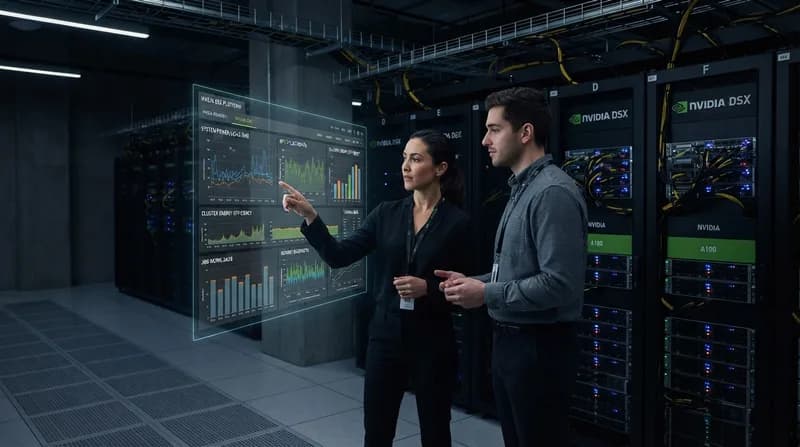
Nvidia is confronting an inconvenient truth: its dominance in the AI market is increasingly restricted by the limitations of the global power grid. As datacenters struggle with aging infrastructure and finite energy supplies, the company's ability to sell more GPUs is effectively being capped by electricity availability. To keep the AI boom moving, Nvidia is shifting its focus toward optimizing datacenter efficiency, effectively turning the entire facility into a cohesive, power-aware ecosystem. Their new DSX platform, unveiled at this week's AI Infra Summit, represents a strategic move to maximize performance per gigawatt.
Datacenters have historically operated with significant power buffers to handle potential spikes, often leaving 15 to 20 percent of their allocated capacity stranded and unusable. Nvidia’s goal with DSX is to reclaim this lost headroom, allowing operators to increase their compute density without requiring a massive expansion of their utility connections. By bridging the gap between GPUs and the physical infrastructure of the datacenter, Nvidia hopes to eliminate the inefficiencies that currently act as a ceiling for AI factory growth.
DSX MaxLPS: Unified Infrastructure Orchestration
The first pillar of the new ecosystem, DSX MaxLPS, seeks to break down the silos between compute resources and facility hardware. Traditionally, cooling units, power cabinets, and AI servers operate as independent entities, leading to wasteful over-provisioning. DSX MaxLPS introduces an API layer—known as DSX Exchange—that allows these diverse assets, including hardware from partners like Schneider Electric and Vertiv, to share real-time telemetry data. By enabling air handlers and cooling systems to communicate directly with compute loads, the platform allows the facility to adjust environmental settings dynamically based on actual, rather than predicted, power draw.
The impact of this integration was recently demonstrated in a pilot program with Lambda. By utilizing the DSX platform to manage the power budget more granularly, the team was able to fit 19 compute nodes into a power envelope that previously supported only 16. This represents a 24 percent increase in cluster-wide throughput, proving that tighter software integration can yield massive gains in performance-per-watt without requiring additional energy from the local utility.
DSX Flex: Intelligent Load Management
Complementing the hardware optimization of MaxLPS is DSX Flex, a system designed to harmonize datacenter operation with the requirements of local grid providers. Rather than forcing datacenters to run at full tilt regardless of grid conditions, DSX Flex implements advanced demand-response capabilities. The system allows utility providers to signal for reduced energy consumption during peak periods, with Nvidia’s software stack automatically pausing non-essential AI workloads or migrating them to regions with excess power capacity.
This is more than just a grid-saving mechanism; it is a strategic business tool. By providing utilities with the guarantee that AI loads can be curtailed or shifted at a moment's notice, Nvidia makes it easier for datacenter operators to secure permits for expanded power capacity. Grid operators can afford to be less conservative with their allocations, knowing that the datacenter can effectively 'breathe' in response to external power fluctuations, rather than serving as an inflexible drain on resources.
Why it Matters
Nvidia’s move into the power management space serves two distinct purposes. First, it directly addresses the critical bottleneck of power infrastructure that threatens the long-term scalability of generative AI models. Second, it deepens the company’s moat, creating a 'walled garden' of integrated hardware and software. While Nvidia suggests there may be paths for third-party accelerators to eventually interface with the DSX ecosystem, the level of granular control required currently makes it a platform designed primarily to keep customers anchored to the Nvidia stack.