The All-In Summit Surprise
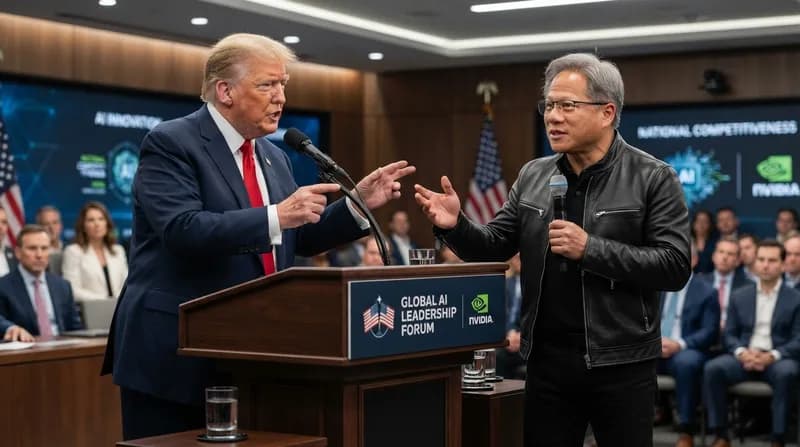
In a moment that likely set social media ablaze, Nvidia CEO Jensen Huang experienced a career-defining public relations scenario while appearing at the All-In Summit in Los Angeles. During his live session with podcast hosts Chamath Palihapitiya, Jason Calacanis, David Friedberg, and David Sacks, Huang received a phone call from President Donald Trump. In a display of spontaneity, Huang opted to place the President on speakerphone, projecting the conversation to the entire assembly of attendees.
The interaction focused on the current geopolitical and strategic landscape of artificial intelligence. While the hosts and Huang had spent the earlier part of their conversation debating whether the industry should heed warnings from leaders like Anthropic’s CEO Dario Amodei, who has publicly suggested slowing down AI capability development, the phone call injected a new, politically charged momentum into the discussion. President Trump made his position clear, characterizing the movement to throttle AI progress as a potential strategic mistake that could hand an advantage to international competitors, specifically citing China.
Aligning on Strategic Growth
The core of the conversation centered on the existential necessity of maintaining U.S. leadership in the AI sector. President Trump dismissed the notion of an AI slowdown as a potential hoax or a political maneuver, expressing strong support for the continued expansion of data center infrastructure. He noted that while the industry should operate with prudence, it should not be derailed by resistance, emphasizing, "We're going to lead."
For his part, Jensen Huang echoed these sentiments, responding to the President with a clear, "We're not going to let that happen, sir." This public exchange highlights a tightening alignment between the current administration and the hardware leaders powering the AI revolution, signaling that Washington remains heavily invested in the rapid deployment of compute resources despite emerging domestic resistance.
Why it Matters: The Data Center Divide
The exchange serves as a focal point for a growing friction in the tech landscape:
- Public Sentiment: Despite high-level government support, local opposition remains strong, with recent Gallup polling indicating that 70% of Americans are wary of new data center construction in their communities.
- Resource Concerns: Over 50% of the public cites environmental strain—such as water usage and energy consumption—as a primary concern, setting up a clash between federal AI goals and local land-use priorities.
- Strategic Competition: Industry leaders and government officials view the rapid expansion of compute infrastructure as a matter of national security, fearing that a pause in U.S. innovation would create a power vacuum for global rivals.
Ultimately, the call between Huang and Trump clarifies that for the current leadership in both government and big tech, the "AI race" is not merely a commercial pursuit but a strategic imperative that necessitates constant, high-speed development, regardless of environmental or social pushback at the municipal level.