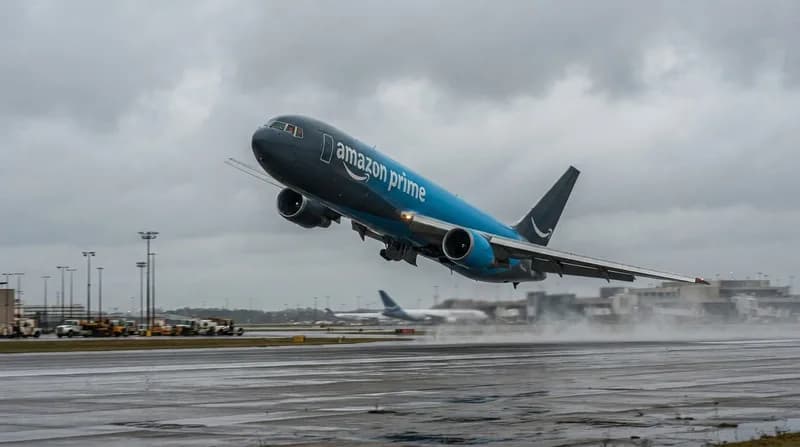
The Final Seconds of Prime Air Flight
The National Transportation Safety Board (NTSB) has released critical preliminary findings regarding the recent tragic crash of an Amazon Prime Air cargo jet. Investigators have confirmed that in the final moments before the impact, the flight crew attempted a 'go-around' maneuver—an emergency procedure where a pilot aborts a landing attempt to climb back to a safe altitude. The data suggests that the engines responded to the throttle input for acceleration, yet the aircraft could not recover its trajectory in time to avoid the fatal collision with the ground.
Investigation into Technical and Environmental Factors
Currently, aviation experts are scrutinizing the wreckage and digital flight data to pinpoint the catalyst for the sudden loss of altitude. The primary focus of the NTSB investigation lies in determining whether the loss of control was precipitated by a critical mechanical failure within the aircraft's control systems or if volatile atmospheric conditions, such as severe wind shear, played a decisive role. The rapid onset of the descent, despite the crew's corrective actions, remains a focal point for safety regulators attempting to reconstruct the sequence of events.
Why it Matters
- Logistical Impact: As a cornerstone of Amazon’s rapid logistics network, this incident places significant operational pressure on the Prime Air fleet.
- Safety Scrutiny: The crash has prompted intensified oversight from civil aviation authorities, who are now conducting a broader review of Prime Air’s flight operations and pilot protocols.
- Technical Analysis: The investigation serves as a stark reminder of the complexities inherent in air cargo operations and the critical nature of pilot-machine interaction during low-altitude maneuvers.
The company has expressed its commitment to transparency, noting that it is fully cooperating with both federal authorities and the contracted flight operator to identify the exact cause of the accident. Until the investigation concludes, the spotlight remains firmly fixed on the structural integrity of the Amazon air delivery network and the safety standards governing its third-party freight partnerships.