Artificial IntelligenceTechnical Deep Dive

NASA Extends SpaceX Crew Dragon Contract as Orbital Uncertainty Looms

Published
EElectricBuzz Editorial Team
NASA Extends SpaceX Crew Dragon Contract as Orbital Uncertainty Looms
3 min read457 wordsElectricBuzz Editorial Team

The Gist

NASA has awarded SpaceX a nearly $1 billion contract modification to ensure consistent astronaut transport to the ISS through 2030.

Ensuring ISS Continuity

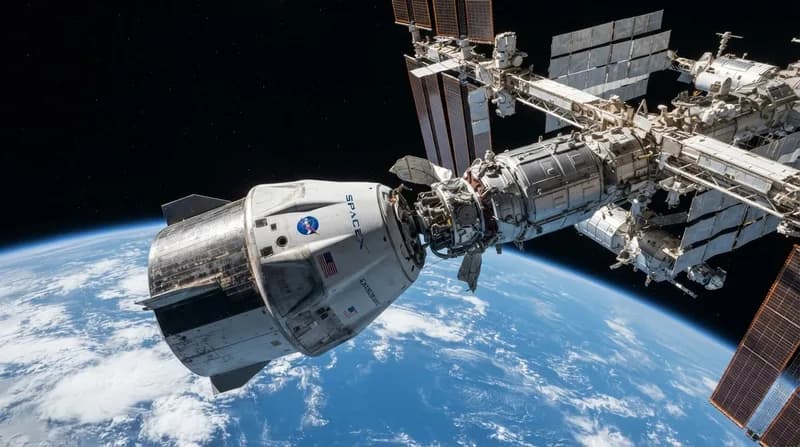
NASA has solidified its reliance on SpaceX for the remainder of the International Space Station’s operational life, awarding the aerospace firm a $946 million contract extension. This deal covers the Crew-15, Crew-16, and Crew-17 missions, ensuring that SpaceX will continue to handle ground operations, launch, in-orbit logistics, and the critical return and recovery of astronauts. By securing these additional flights, the total value of SpaceX’s Commercial Crew Transportation Capability (CCtCap) contract now stands at approximately $5.92 billion.

The agreement underscores the vital role SpaceX has played in maintaining a human presence in low Earth orbit. While NASA has indicated that this specific award does not preclude the agency from purchasing additional transport services from other providers in the future, the decision reflects the current reality of the space flight landscape. With the International Space Station slated for a controlled decommissioning around 2030, this contract ensures that the primary vehicle for crew rotation remains stable until the final deorbit sequence begins.

Why it Matters: The Starliner Disparity

The contract extension highlights a stark contrast between the two original commercial crew partners. When NASA awarded contracts to both Boeing and SpaceX in 2014, the intent was to foster a competitive market with redundant systems. However, while SpaceX’s Crew Dragon has become the workhorse of American human spaceflight, Boeing’s Starliner has faced repeated technical failures and safety concerns.

The disparity reached a critical point in 2024, when NASA determined that returning crew members via Starliner posed unacceptable risks, eventually relying on a SpaceX mission to bring those astronauts home. Despite significant financial investment, Starliner’s future in the regular crew rotation remains speculative at best. NASA’s latest move with SpaceX is, therefore, a strategic necessity to guarantee that the U.S. retains reliable access to the ISS without the volatility that has plagued Boeing’s program.

The Road to 2030 and Beyond

Looking ahead, the aerospace industry is already preparing for a post-ISS era. NASA has tasked SpaceX with developing a specialized vehicle to facilitate the station’s eventual deorbit, cementing the company’s indispensable status within the agency’s long-term roadmap. Meanwhile, SpaceX is simultaneously navigating its own transition; the company intends to eventually shift its operational focus from the proven Falcon 9 and Crew Dragon architecture to the heavy-lift, next-generation Starship platform.

While these new missions are currently scheduled for readiness windows in 2027 and 2028, they also represent the potential sunset of the Crew Dragon program. As the station nears its end-of-life, these missions may be among the final human-crewed flights to the outpost. Whether this marks the end of the Dragon era or simply a bridge to future commercial space stations remains to be seen, but for now, SpaceX remains the undisputed primary operator for NASA’s human spaceflight ambitions.


The 5 Best Over-Ear ANC Headphones of 2026, Tested & Ranked
Editor's Pick Guide
92/100
Tech & Gadgets12 min read

The 5 Best Over-Ear ANC Headphones of 2026, Tested & Ranked

We locked five over-ear ANC picks for 2026 — Sony WH-1000XM6, Bose QuietComfort Ultra 2, Soundcore Space One, Sennheiser Momentum 5, and Apple AirPods Max 2 — then stress-tested them on lab metrics, long-term owner truth, and live street prices.

Related Stories

Semantically matched articles, ranked by topic overlap and freshness.

Hugging Face Integrates Enterprise Hub with AWS Marketplace
Artificial Intelligence

Hugging Face Integrates Enterprise Hub with AWS Marketplace

Hugging Face now allows organizations to manage their AI development subscriptions directly through AWS, simplifying billing and procurement for enterprise teams.

Tabby Aims to Make Small Business Accounting Invisible with AI
Artificial Intelligence

Tabby Aims to Make Small Business Accounting Invisible with AI

Former accountant Ahad Ali is looking to disrupt the traditional bookkeeping industry by replacing complex SaaS platforms with a fully automated, AI-driven financial interface.

Hugging Face Unveils Tokenizers v1: A Massive Leap in AI Processing Speed
Artificial Intelligence

Hugging Face Unveils Tokenizers v1: A Massive Leap in AI Processing Speed

Hugging Face has announced the release candidate for Tokenizers v1, a major performance overhaul designed to eliminate bottlenecks in machine learning pipelines.

Google Unveils the 'Googlebook': A Bold Leap into AI-Integrated Hardware
Artificial Intelligence

Google Unveils the 'Googlebook': A Bold Leap into AI-Integrated Hardware

Google is officially opening pre-orders for the Googlebook, an $899 laptop engineered to place Gemini AI at the center of the desktop computing experience.

Quantum Physics Meets AI: A New Era for LLM Pruning
Artificial Intelligence

Quantum Physics Meets AI: A New Era for LLM Pruning

Researchers are borrowing concepts from statistical mechanics to dramatically optimize Large Language Model efficiency through a novel block-pruning technique.

Schneider Electric Reveals Blueprint for Greener, Less Water-Intensive AI Data Centers
Artificial Intelligence

Schneider Electric Reveals Blueprint for Greener, Less Water-Intensive AI Data Centers

New modeling from Schneider Electric suggests that shifting to higher-temperature liquid cooling could slash water consumption in massive AI server farms by over 50 percent.

Hugging Face Enhances Enterprise Hub with Regional Data Residency
Artificial Intelligence

Hugging Face Enhances Enterprise Hub with Regional Data Residency

Hugging Face is rolling out Storage Regions, allowing enterprise users to pin their AI models and datasets to specific geographic data centers for compliance and performance.

Scaling Intelligence: Hugging Face Simplifies Embedding Model Deployment
Artificial Intelligence

Scaling Intelligence: Hugging Face Simplifies Embedding Model Deployment

Hugging Face has streamlined the process of deploying powerful embedding models, making it easier than ever to integrate state-of-the-art vector representations into production workflows.