The Intersection of Linguistics and Neuroscience
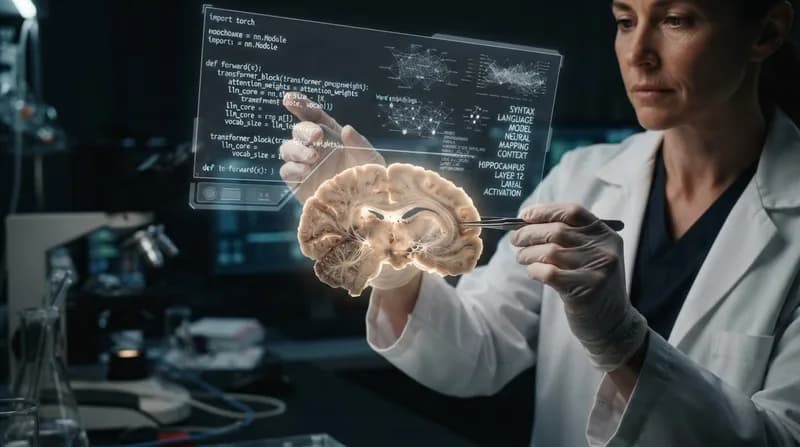
For decades, neuroscientists have sought to understand the biological mechanisms behind language comprehension—specifically, how the brain shifts from perceiving mere acoustic signals to deciphering complex semantic meanings. A new study, published in Nature Neuroscience, bridges this gap by utilizing the architecture of Large Language Models (LLMs) to decode the activity of human brain cells. By analyzing how these artificial models represent language, researchers have uncovered evidence that the human hippocampus plays a critical role in mapping the relationships between word meanings and their broader contexts.
Led by a collaborative team from Baylor College of Medicine, Rice University, the University of California, Berkeley, and Texas Children's Hospital, the research utilized data from 10 patients. By recording neural activity via implanted electrodes during clinical procedures, the team observed how individual hippocampal neurons responded as participants listened to narrative stories. This setup provided a unique window into real-time semantic processing that is rarely accessible in non-clinical settings.
Predictive Models and Semantic Encoding
The research team employed an 'encoding model' approach to determine whether the mathematical representations used in LLMs could accurately predict the firing patterns of human neurons. By comparing the neural data to the vector-based embeddings produced by models like GPT-2, the researchers identified a striking correlation: the semantic distance between words in an LLM’s latent space mirrors the distance between neural population responses in the human brain. This suggests that the brain and artificial systems may converge on similar strategies for organizing language, specifically through 'contrastive coding' that helps filter out environmental noise.
Furthermore, the team examined the concept of polysemy—the capacity for a word to hold multiple, related meanings depending on its environment. Their findings indicate that hippocampal activity is not rigid; rather, it is highly contextualized. The variation in neural response patterns tracked closely with LLM-derived polysemy measures, suggesting that groups of neurons in the hippocampus function as a dynamic network capable of adjusting the 'weight' of a word's meaning based on the story’s flow.
Why It Matters
- Neurocomputational Insights: The study provides a tangible account of how biological memory structures handle abstract semantic data, moving beyond the idea that the hippocampus is limited solely to episodic memory.
- AI-Brain Convergence: The success of using LLM embeddings to map brain activity confirms that modern AI architectures serve as effective proxies for human cognitive processes.
- Clinical Applications: By understanding the neural basis of language processing, this research could eventually inform new diagnostic tools or therapies for patients with language or memory-related neurological disorders.
Future Directions in Cognitive Mapping
This study represents a significant leap forward in cognitive neuroscience, demonstrating that the future of understanding the human mind may be inextricably linked to our progress in AI. By using LLMs as a diagnostic lens, researchers were able to confirm that semantic encoding is a collective effort distributed across hippocampal neuron populations. Looking ahead, this methodology opens a new frontier for investigating how other brain regions process complex linguistic structures, potentially leading to a more comprehensive map of the human language center. As LLMs continue to evolve, they will likely become an indispensable tool in the researcher’s kit, providing the mathematical framework needed to decode the brain's most intricate linguistic secrets.