Reconstructing the Cosmic Dawn
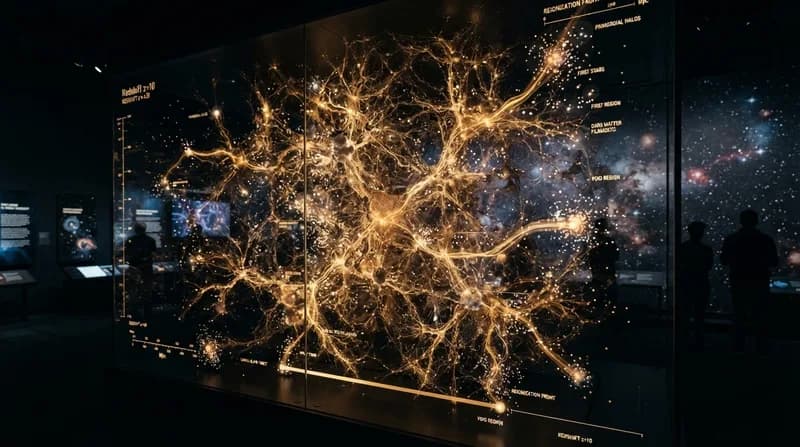
In a monumental achievement for both astrophysics and computational science, a team of researchers from MIT, Harvard, and international partners has unveiled Lumina, a groundbreaking supercomputer simulation. Designed to shed light on one of the most enigmatic chapters in history—the cosmic dark age—this model recreates two billion years of early cosmic evolution across a staggering volume of 1.6 billion light-years. By synthesizing the complex physics of dark matter, gas, radiation, and galaxy formation, Lumina provides an unprecedented look at how the primordial universe transitioned from a neutral, lightless state to a vibrant cosmos filled with stars, galaxies, and black holes.
The Mechanics of Lumina
Lumina builds upon the legacy of the IllustrisTNG project but expands its scope and capability by orders of magnitude. The simulation features approximately half a trillion individual elements, including particles of dark matter and sophisticated cells representing gas structures. To manage this immense computational load, the researchers utilized the Frontier supercomputer at Oak Ridge National Laboratory, which coordinates the work of 100,000 CPU cores and 15,000 GPUs. This massive infrastructure allows the simulation to resolve details at the scale of individual galaxies while simultaneously tracking the large-scale radiation transport that defined the era of re-ionization.
The integration of a specialized radiation transport model is what truly sets Lumina apart. It allows scientists to visualize the precise moment when the first generation of stars and supermassive black holes began to emit enough ultraviolet radiation to strip electrons from hydrogen and helium atoms. This process, known as re-ionization, eventually cleared the 'fog' of neutral hydrogen that had filled space for millions of years, making the universe transparent and enabling light to travel across the vast reaches of space we observe today.
Why It Matters
- Scaling the Impossible: Lumina covers a region 100 times larger than previous leading simulations while maintaining 30 times the resolution, offering a bridge between micro-scale galaxy formation and macro-scale cosmic structure.
- Dual Ionization Insights: For the first time, researchers can observe how different drivers—early stars for hydrogen and supermassive black holes for helium—worked in tandem to transform the early cosmos.
- Direct Observational Comparisons: By producing an enormous population of virtual galaxies, Lumina provides a data-rich baseline that astronomers can use to compare with real-world findings from next-generation space telescopes.
- Computational Mastery: The project demonstrates a new peak in computer engineering, proving that human researchers can now harmonize trillions of interacting data points to simulate the birth of the observable universe.
A New Era for Cosmic Research
The implications of the Lumina project extend far beyond pure visualization. Because the team has made the simulation accessible to the global scientific community, it serves as a foundational resource for testing new theories regarding the arrangement of dark matter and the formation of the earliest structures. As upcoming surveys provide ever-sharper images of the deep universe, Lumina will act as a digital lens through which scientists can interpret those findings. By bridging the gap between theoretical physics and incoming observational data, this virtual universe is poised to solve long-standing mysteries about how the cosmos arrived at its current, light-filled state billions of years after the Big Bang.