A New Aqueous Paradigm
For generations, the prevailing theory regarding Earth's water has been one of delivery. Scientists have long argued that our planet’s oceans were brought here via a chaotic bombardment of icy comets and carbonaceous asteroids. However, a groundbreaking study published in Nature Geoscience by researchers at the University of New Mexico challenges this extraterrestrial-dependency narrative. The findings propose that Earth’s water may be a natural byproduct of its own violent, high-temperature birth, suggesting that water is a 'built-in' component of terrestrial planet formation.
Led by graduate student Susmita Garai and Professor Zachary Sharp, the research team investigated the chemical dynamics of the early Earth. By simulating the extreme heat and hydrogen-rich atmosphere present during the planet's infancy, they discovered that water isn't just something that falls from space—it is something that a growing rocky planet can manufacture on an industrial scale through simple, high-speed chemical reactions.
The Chemistry of Creation
The core of this discovery lies in the process of 'pebble accretion,' where small, iron-rich rocky fragments collided to build the mass of the young Earth. The researchers hypothesized that as these rocks fell through a dense, hydrogen-rich atmosphere, they underwent a reduction reaction. In their controlled lab experiments, the team exposed silicate rock samples—containing iron oxide—to temperatures between 1,200 and 1,400 degrees Celsius in a hydrogen-rich environment.
The results were immediate and startling. Within minutes, the hydrogen gas reacted with the iron oxide in the rocks, converting it into metallic iron while simultaneously shedding water vapor as a byproduct. To verify the reaction, the team ran a control group using helium, which failed to produce water, confirming that the presence of hydrogen was the vital catalyst for this planetary water-making machine. The efficiency of this process implies that during Earth's accretion, this mechanism could have generated the equivalent of hundreds of oceans.
Why It Matters
- Habitability by Default: If water is a common byproduct of rocky planet formation, the number of potentially habitable worlds in the universe could be exponentially higher than current estimates suggest.
- Redefining Planet Formation: The study shifts the focus from external water delivery systems (comets/asteroids) to internal planetary geology as the primary source of life-sustaining volatiles.
- Pebble Accretion Validation: This evidence strengthens the newer paradigm of 'pebble accretion,' which helps explain several long-standing inconsistencies in how planets grow from space dust to massive bodies.
Implications for the Universe
The implications of this study are profound for the field of astrobiology. If Earth-sized planets naturally manufacture their own water supply during their development, the search for life beyond our solar system gains a new, optimistic filter. Scientists no longer need to assume that a planet must be 'hit' by the right icy objects to be considered viable for life; instead, they can look at the chemical composition of a star system and the presence of hydrogen as indicators that a planet could possess its own massive, internal reservoirs of water.
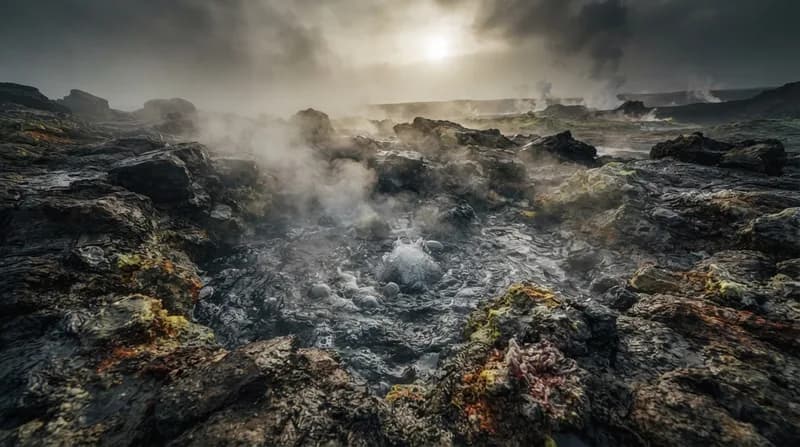
While the team acknowledges that further research is required to quantify exactly how much of Earth's current water came from this process versus later extraterrestrial arrivals, the discovery fundamentally changes how we view the 'fiery' beginnings of our home planet. What was once thought to be a chaotic, hell-like environment of molten rock may have been the very factory that distilled the building blocks for every drop of water on Earth today.