The Mechanics of Biodynamic Imaging
Purdue University physicist David Nolte has introduced a groundbreaking diagnostic technology known as 'biodynamic imaging' that promises to shift cancer treatment from a trial-and-error approach to a precision science. By combining the precision of laser light with the principles of the Doppler effect, this system can observe the infinitesimal movements of cellular machinery within living tissue samples. While traditional medical imaging, such as standard microscopy, X-rays, or MRIs, struggles to capture the granular kinetics of cells, Nolte’s system achieves sensitivity down to the picometer scale, allowing researchers to track cellular activity at speeds as slow as the diameter of a hydrogen atom per second.
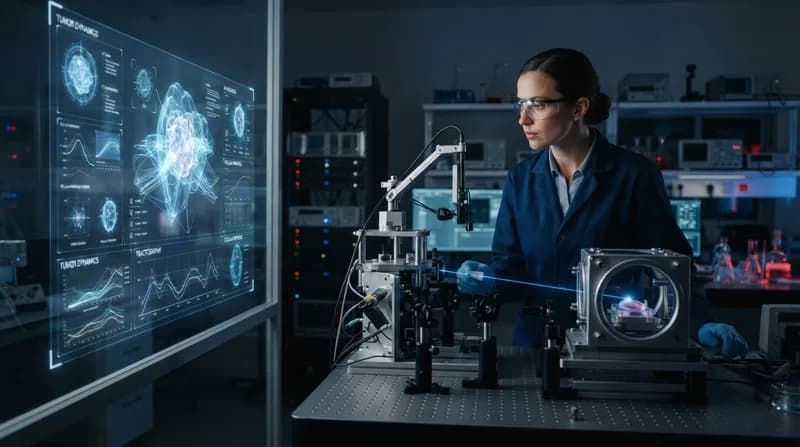
The system operates by bouncing laser light—which maintains high coherence, unlike standard white light—off tumor biopsies. Because laser pulses are uniform and predictable, they act as an exceptionally sensitive probe for motion. As chemotherapy drugs are introduced to the living tissue, the system captures how those drugs alter the 'cellular dance.' By monitoring whether these internal biological movements speed up or slow down, the platform provides a quantitative map of how a specific tumor reacts to a particular pharmaceutical agent in real-time.
Integrating AI for Predictive Diagnostics
The sheer volume of data generated by nanometer-scale movement tracking is immense, necessitating a sophisticated computational layer. To translate these subtle physical signals into actionable medical intelligence, Nolte has integrated AI algorithms trained on extensive sets of known clinical outcomes. These models function much like current image recognition software, learning to associate specific patterns of cellular motion with successful or unsuccessful drug responses.
This integration is currently being put to the test at the Indiana University School of Medicine. Researchers there are using the system to evaluate experimental chemotherapy drugs against tumor cells derived from over 30 osteosarcoma patients. By creating a 'reference atlas' of patient-derived models, the team can run a battery of drug combinations against the tissue to determine the most effective course of action. This method effectively streamlines the drug development pipeline, potentially saving months or years of clinical testing by identifying non-responders early in the process.
Why It Matters
- Reduced Toxicity: By identifying which chemotherapy drugs will be ineffective before they are administered to a patient, physicians can avoid exposing patients to unnecessary, harsh side effects.
- Rapid Turnaround: The system aims to provide results within 48 hours of a biopsy, which is a significant improvement over traditional diagnostic timelines.
- Broad Applicability: While currently focused on oncology, the biodynamic imaging system is also being explored for applications in assessing IVF embryo viability and detecting viral or bacterial infections.
- Clinical Validation: Previous studies using this technology have already demonstrated success in predicting chemoresistance in human esophageal carcinoma and bladder cancer cases.
Future Outlook: Transforming Standard of Care
The implications for oncology are vast, with potential future trials aiming to standardize this diagnostic method for common conditions like breast cancer. Nolte envisions a future where a clinician receives a definitive report following a biopsy: 'This patient will respond better to regimen A than to regimen B.' Moving beyond the lab and into prospective clinical trials could fundamentally rewrite the standards of care in the United States, replacing regional treatment preferences with data-driven, patient-specific drug selection.
With a recently awarded patent for a more user-friendly iteration of the hardware, the transition from research tool to clinical staple seems increasingly plausible. By harnessing the physical behavior of light to interpret the biological behavior of cancer, this innovation stands at the vanguard of the next generation of precision medicine.