A Hidden Treasure Unearthed
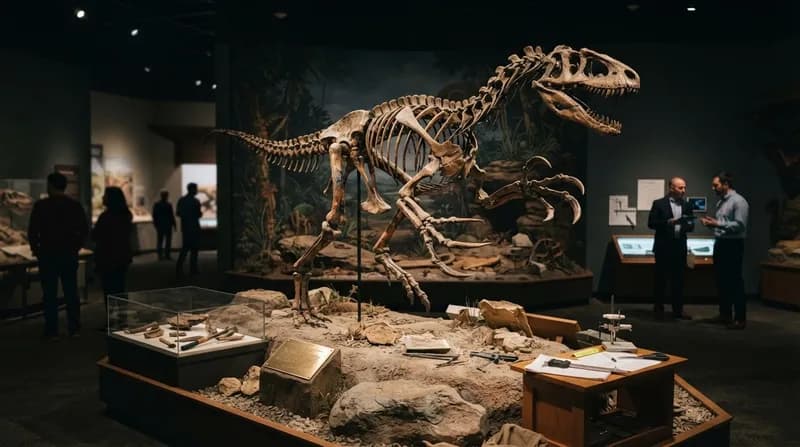
For nearly a hundred years, a modest skull fragment sat tucked away in the archives of London's Natural History Museum, its significance entirely overlooked. Originally collected in 1924 by amateur paleontologist Reginald Walter Tooley on the Isle of Wight, the fossil was recently re-examined by a team led by University College London (UCL). Their findings, published in Royal Society Open Science, reveal that the specimen belongs to a previously unknown species of carnivorous dinosaur: Invictibellatrix amberina.
This "unconquered female warrior" is a significant find for the scientific community, as it marks the first concrete evidence of megaraptorans in Europe. These agile, two-legged predators were distinct from their tyrannosaur relatives, favoring long, powerful arms and formidable, curved claws over the massive bite force typically associated with apex hunters of the Cretaceous period.
The Anatomy of an Early Predator
Utilizing advanced CT scanning and three-dimensional reconstruction, researchers were able to map the dinosaur's internal skull structure. The scans identified unique diagnostic features, including an hourglass-shaped crest and a specific oval opening for the spinal cord, which allowed the team to distinguish Invictibellatrix from known theropods. The dinosaur was roughly the size of a large tiger, measuring approximately three to four meters in length and standing about 1.5 meters tall.
While it may not have been the apex predator of its ecosystem, the researchers note that its specialized physiology would have made it a highly effective hunter of small mammals, lizards, and other dinosaurs. Because of its size and predatory behavior, the team suggests that for a human, encountering such an animal would have been considerably more dangerous than crossing paths with a Tyrannosaurus rex, which would have likely dismissed a human as being too small to warrant a hunt.
Rewriting Megaraptoran Evolution
Beyond the physical description of the species, this discovery provides a critical missing link in the biogeography of megaraptorans. Previously, researchers were puzzled by how these mysterious predators managed to reach the southern supercontinent of Gondwana. The prevailing theories struggled to explain the gap in the fossil record across the northern hemisphere.
The identification of Invictibellatrix in the UK serves as a geographic bridge. It confirms that Europe played a pivotal role as a migratory corridor. From here, these dinosaurs evolved and dispersed southward, where they eventually grew into the massive, elephant-sized giants like Maip macrothorax found in Argentina. This finding effectively settles the debate regarding the migration route of these dinosaurs and underscores the importance of re-evaluating historical museum collections.
Why It Matters
- Evolutionary Insight: Fills a major gap in the Early Cretaceous timeline, linking northern and southern predator distributions.
- Methodological Success: Demonstrates the power of combining 100-year-old fossil data with modern high-resolution CT imaging and algorithmic analysis.
- Museum Value: Highlights that world-class scientific discoveries may still be hiding in plain sight within existing, under-studied museum archives.
As the scientific community continues to analyze the Isle of Wight's rich geological layers, this discovery reminds us that the past is far from fully understood. For now, Invictibellatrix amberina stands as a symbol of resilience—both in the biological sense of its lineage's survival across continents and as a symbolic tribute to the researchers who finally brought this "warrior" into the light.