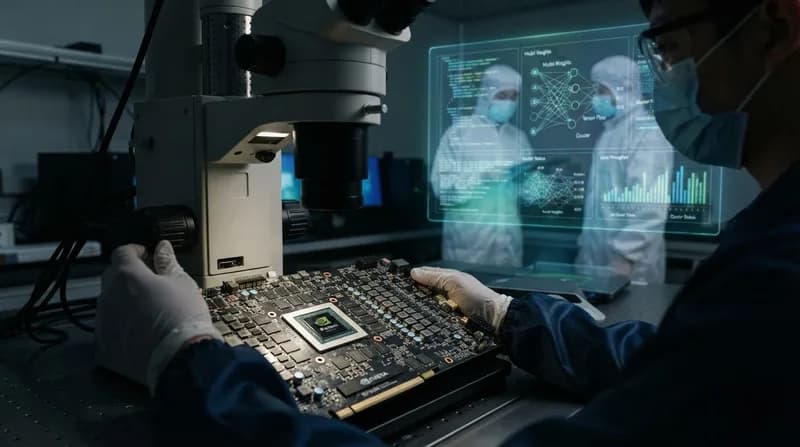
A Digital Fingerprint in AI Weights
In a revelation that challenges the efficacy of current geopolitical trade restrictions, former OpenAI engineer Will DePue has uncovered evidence suggesting that top-tier Chinese AI labs are training their frontier models on Nvidia’s cutting-edge Blackwell architecture. By analyzing the published weights of several prominent models, DePue’s firm, Unemployment Labs, identified distinct patterns—or digital fingerprints—left behind during the model initialization process that can be traced back to specific hardware configurations.
The technical foundation of this discovery lies in how AI models are initialized. Before training begins, model parameters, or weights, are set using pseudorandom number generators. Because these processes rely on specific GPU threads and libraries like Nvidia’s cuRAND, the resulting patterns in the weights are not truly random; they are hardware-dependent. By testing over six trillion combinations of chip architectures and seed values, DePue successfully matched the initialization signatures of models from DeepSeek, Moonshot AI, MiniMax, and Ant Group to the Nvidia Grace Blackwell GB200 and GB300 systems.
The Scope of Unauthorized Access
The forensic report specifically names several high-profile AI models that appear to carry the Blackwell signature. Notably, the DeepSeek-V4-Flash model, as well as the Kimi K3 and MiniMax-M3, showed conclusive evidence of being initialized on the restricted liquid-cooled hardware. While researchers noted that the presence of these fingerprints does not definitively prove the physical location of the GPUs, the implication is clear: the most powerful computing resources on the planet are finding their way into the hands of labs operating within China, circumventing strict export oversight.
This is not the first indication that Nvidia's latest technology is entering the region. Recent findings from security firm Lava identified 32 Nvidia B300 GPUs through exposed monitoring endpoints with IP addresses geolocated in China. Taken together, these reports suggest that the "leaky" nature of the current supply chain, potentially aided by third-party cloud providers or illicit smuggling channels, remains a major hurdle for Western regulators.
Why It Matters
- Policy Failure: These findings cast doubt on the effectiveness of current US export controls, leading to legislative pressure for more restrictive measures like the proposed AI Overwatch Act.
- Technological Parity: If Chinese labs can train on Blackwell hardware, the gap in AI capabilities between Western companies and their Chinese counterparts may narrow much faster than policymakers anticipated.
- Forensic Verification: The ability to "fingerprint" hardware through model weights introduces a new paradigm in verifying AI supply chains and ensuring compliance with international trade law.
The Path Toward Stricter Controls
The discovery comes at a volatile time for Nvidia and the broader AI sector. Following the resignation of CEO Jensen Huang and ongoing investigations into potential chip smuggling, Washington is under increasing pressure to act. Legislative bodies are currently reviewing a suite of bills, including the Cloud Security Act, which seeks to close existing loopholes that allow entities to access controlled computing power through remote cloud-based services.
While the Chinese labs involved have yet to comment on the methodology, the validation of these findings by senior researchers at major labs like OpenAI and Anthropic provides significant credibility to DePue’s report. As AI development continues to scale, the intersection of hardware provenance and national security will likely become a primary focus for both the tech industry and global governments.