The Rise of Megawatt-Class Infrastructure
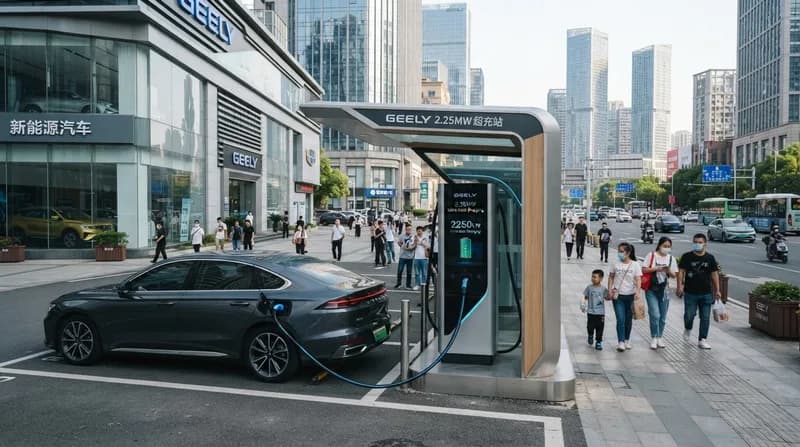
The race to eliminate charging anxiety has shifted into high gear with Geely’s latest infrastructure deployment. Hot on the heels of announcing its 2,250 kW ultra-fast charging system, the automotive giant has officially begun installing its new "Smart Charging C12" stations. These units are now operational across five major Chinese cities, including Hangzhou, Shanghai, Ningbo, Jiaxing, and Xi’an. This rapid rollout positions Geely as a direct challenger to BYD’s dominance in the ultra-fast charging sector, aiming to redefine the consumer experience for owners of Zeekr and Lynk & Co vehicles.
The nomenclature "C12" refers to the impressive 12C charging rate, a metric indicating the speed of energy transfer relative to battery capacity. While theoretical calculations suggest a five-minute charge time, real-world performance is already delivering 10 to 97 percent charge in under nine minutes for compatible vehicles. Currently, models like the Zeekr 001 and Lynk & Co 10 are capable of utilizing this infrastructure, hitting peak charging powers of approximately 1,100 kW, with future high-voltage architectures expected to push those boundaries even further.
Intelligence-Driven Thermal Management
Managing the massive thermal loads associated with 2,250 kW of power requires more than just high-capacity cables; it demands sophisticated, proactive control. To solve this, Geely has implemented the "Xingrui PowerMind" system, an AI-driven platform developed in collaboration with StepFun. This intelligent ecosystem creates a continuous communication loop between the vehicle, the grid, cloud servers, and the charging station itself to optimize energy delivery in real-time.
The system’s primary function is predictive thermal management. By forecasting battery temperatures up to 30 seconds ahead of time, PowerMind can dynamically adjust charging currents to keep internal temperatures strictly regulated. Geely’s target is to maintain average charging temperatures below 55 degrees Celsius, with peaks strictly capped at 65 degrees. This is achieved through an integrated, end-to-end liquid cooling solution that circulates coolant from the stationary storage unit, through the delivery cables, and directly into the vehicle's battery pack.
Why It Matters
- Closing the Gap: The ability to charge from 10% to 97% in under nine minutes essentially eliminates the traditional "refueling time" argument against EV adoption.
- AI Integration: By utilizing predictive AI like PowerMind, Geely is shifting the burden of safety and longevity from the hardware components to intelligent software-defined power management.
- Global Expansion Plans: While the current focus is on the Chinese market, Geely has signaled intent to bring similar, albeit slightly adjusted, 1,000 kW ultra-fast charging solutions to the German market through local partnerships.
Competitive Landscape and Future Outlook
The infrastructure wars in China have intensified as companies realize that the ecosystem is just as important as the car itself. BYD is currently maintaining a massive footprint with over 10,000 active Flash Charging stations and plans to double that figure by the end of 2026. Meanwhile, battery specialist Sunwoda has entered the fray with its own 15C-capable technology, pledging to construct 10,000 megawatt-class chargers by 2027.
Geely is not standing still, as evidenced by its work on a new 1,000-volt high-voltage architecture. This next-generation platform aims to drop the 10-to-80 percent charging window to under 5.5 minutes. As these companies continue to push the boundaries of C-rates and thermal management, the industry is moving closer to a future where charging an EV is no longer a stop-and-wait experience, but a rapid, seamless interaction comparable to legacy combustion refueling.