E-BUZZ ME Logo
ScienceTechnical Deep Dive

Gauge Theory Reimagines the Foundations of Thermodynamics After Two Centuries

Published
Gauge Theory Reimagines the Foundations of Thermodynamics After Two Centuries
1 min read145 words

The Gist

Researchers are applying gauge theory to thermodynamics, potentially providing a more robust mathematical framework for the laws governing heat and work.

A New Mathematical Foundation

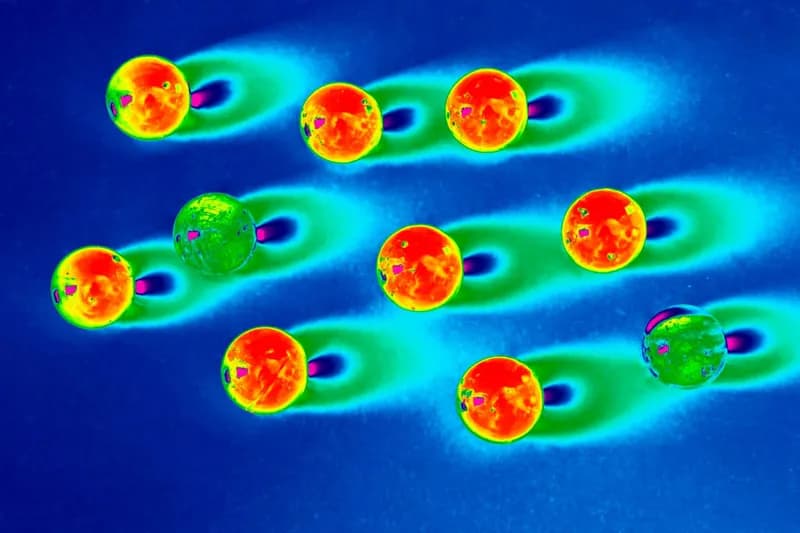
For over 200 years, the laws of thermodynamics have served as a cornerstone of physics, describing the intricate relationships between heat, energy, and work. However, recent developments suggest that these classical principles are receiving a significant mathematical upgrade. Scientists are now utilizing 'gauge theory'—a framework traditionally used to understand fundamental forces and quantum fields—to provide thermodynamics with a more precise footing.

Bridging Classical and Quantum Physics

Gauge theory is renowned for its success in particle physics, where it helps define how physical quantities remain invariant under certain transformations. By applying this logic to thermal systems, researchers hope to resolve long-standing mathematical ambiguities in how energy transfers are calculated. This shift does not change the physical outcomes of thermodynamic laws but offers a more sophisticated language to describe them, potentially opening new doors in the study of non-equilibrium systems and quantum thermodynamics.

Related Stories

Semantically matched articles, ranked by topic overlap and freshness.

Fields Medal 2026: Mathematicians Honored for Unifying Physics Laws
Science73%

Fields Medal 2026: Mathematicians Honored for Unifying Physics Laws

The prestigious Fields Medal has been awarded to mathematicians whose groundbreaking work bridges the gap between geometry and the fundamental laws of physics.

Quarks and Qubits: The Quantum Computing Revolution in Particle Physics
Science67%

Quarks and Qubits: The Quantum Computing Revolution in Particle Physics

New research explores how the intersection of quantum information and general relativity could redefine our understanding of subatomic particles.

Simple AI Prompt Resolves Decades-Old Mathematical Conjecture
Science66%

Simple AI Prompt Resolves Decades-Old Mathematical Conjecture

For the second time in a week, artificial intelligence has disproved a long-standing mathematical conjecture using surprisingly basic prompts.

New Study Challenges the Existence of Dark Energy
Science63%

New Study Challenges the Existence of Dark Energy

A controversial research paper suggests that the universe’s expansion may not be accelerating, potentially eliminating the need for dark energy as a scientific explanation.

Unlocking New Conductivity Pathways in Mott Insulators
Science63%

Unlocking New Conductivity Pathways in Mott Insulators

Recent research into laser-driven feedback effects in Mott insulators reveals groundbreaking methods for engineering conductivity in strongly interacting systems.

Breakthrough Fluoride-Free Gel Could Regrow Damaged Tooth Enamel
Science62%

Breakthrough Fluoride-Free Gel Could Regrow Damaged Tooth Enamel

Researchers have developed a protein-inspired gel that mimics natural tooth formation to repair microscopic cracks and rebuild enamel.

Super El Niño Set to Break 150-Year Temperature Records
Science61%

Super El Niño Set to Break 150-Year Temperature Records

A developing 'super' El Niño in the tropical Pacific has a 90 percent chance of becoming the strongest in recorded history, threatening unprecedented global heat.

Predictable Antarctic Ice Loss Offers Decades for Sea Level Preparation
Science60%

Predictable Antarctic Ice Loss Offers Decades for Sea Level Preparation

New research suggests that Antarctic ice retreat may remain predictable through 2050, giving governments a critical window to implement coastal defenses.