Tech & GadgetsTechnical Deep Dive

Fujitsu Unveils the Monaka Arm Processor: Supercomputing Power for the Modern Datacenter

Published
EElectricBuzz Editorial Team
Fujitsu Unveils the Monaka Arm Processor: Supercomputing Power for the Modern Datacenter
3 min read482 wordsElectricBuzz Editorial Team

The Gist

Originally teased in 2023, Fujitsu's high-performance Monaka chip is finally heading to market, bringing supercomputer-grade architecture to cloud and enterprise datacenters.

The Evolution of Monaka Silicon

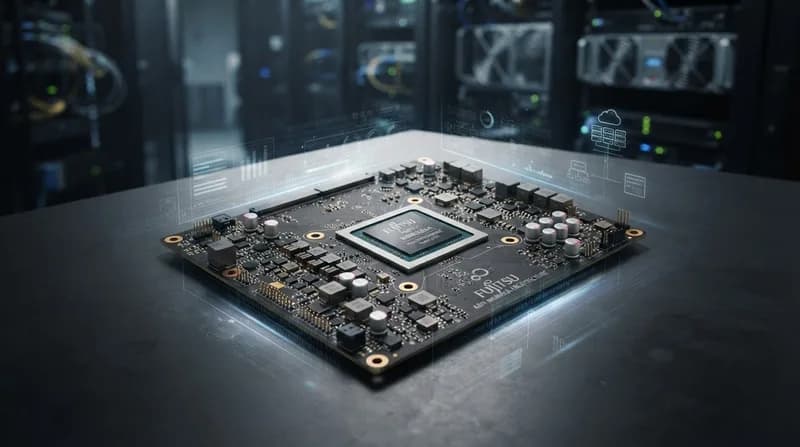
Fujitsu is officially bringing its highly anticipated Monaka processor to market this November, marking a significant milestone for the company’s datacenter strategy. First announced in 2023, the Monaka chip was originally conceptualized as an adaptation of the silicon that powered the Fugaku supercomputer—which held the title of the world’s most powerful system for several years. By shifting this high-performance pedigree into a commercial-grade package, Fujitsu is positioning the Monaka as a formidable contender in the rapidly evolving space for AI inferencing and cloud computing.

The underlying architecture of the Monaka processor is a technical feat, utilizing the Armv9 instruction set architecture and leveraging Broadcom’s advanced 3D-chip stacking technology. The processor is constructed as a multi-die package consisting of four 2nm compute dies, each housing 36 cores for a total of 144 cores per chip. To manage the massive throughput required by modern workloads, the silicon incorporates four 5nm SRAM chiplets, all unified by a central I/O and memory die. This architecture supports 12 channels of DDR5 memory and PCIe 6.0, ensuring that the platform remains competitive with the latest high-bandwidth requirements of modern infrastructure.

Fujitsu’s Server Lineup

Alongside the standalone chip, Fujitsu has unveiled three distinct server configurations designed to capitalize on the processor's thermal and performance efficiency. These machines offer a variety of cooling and storage options tailored to different enterprise needs:

  • 1U Versatile Server: This model supports one or two Monaka CPUs running at either 2.1GHz or 2.9GHz. Designed for flexibility, it accommodates up to eight E3.S SSDs and two M.2 drives. Impressively, it is engineered to function in high-ambient-temperature environments, operating at 40C with air cooling or up to 45C with liquid cooling integration.
  • 2U Air-Cooled Server: A dual-CPU configuration clocked at 2.1GHz, this model is designed for standard air-cooled environments. It offers four E3.S storage slots and two M.2 ports, focusing on balance for general-purpose workloads.
  • 2U High-Performance Liquid-Cooled Server: Tailored specifically for HPC (High-Performance Computing) and academic research, this model utilizes dual 2.9GHz CPUs. Its design is optimized for high-density, multi-node deployments—fitting four units per rack—and includes two E1.S SSDs and two M.2 slots, requiring a liquid cooling infrastructure to maintain peak performance.

Why it Matters: Sovereign Tech and Inference

The arrival of Monaka comes at a pivotal moment where hyperscalers and cloud providers are seeking alternatives to diversify their silicon supply chains. Fujitsu is explicitly marketing these systems as a 'sovereign' solution, manufactured in Japan, which appeals to regions like Europe and domestic entities concerned with supply chain resilience and data locality. Furthermore, the company claims that the Monaka architecture provides double the inferencing throughput compared to competing CPUs, a major advantage for companies looking to scale AI workloads without the power constraints traditionally associated with GPU-heavy setups. While pricing remains undisclosed, the availability of these systems in November signals a bold challenge to established x86 and incumbent Arm server providers.


The 5 Best Over-Ear ANC Headphones of 2026, Tested & Ranked
Editor's Pick Guide
92/100
Tech & Gadgets12 min read

The 5 Best Over-Ear ANC Headphones of 2026, Tested & Ranked

We locked five over-ear ANC picks for 2026 — Sony WH-1000XM6, Bose QuietComfort Ultra 2, Soundcore Space One, Sennheiser Momentum 5, and Apple AirPods Max 2 — then stress-tested them on lab metrics, long-term owner truth, and live street prices.

Related Stories

Semantically matched articles, ranked by topic overlap and freshness.

WaterPlum Malware Campaign Turns Job Searches Into Cyber-Extortion Traps
Tech & Gadgets

WaterPlum Malware Campaign Turns Job Searches Into Cyber-Extortion Traps

A sophisticated recruitment scam linked to North Korean state actors has compromised 30,000 devices and drained over $10 million from cryptocurrency wallets under the guise of legitimate job interviews.

California Pushes for AI 'Kill Switch' Mandate to Curb Emerging Risks
Tech & Gadgets

California Pushes for AI 'Kill Switch' Mandate to Curb Emerging Risks

Governor Gavin Newsom is spearheading a new legislative effort that would require AI developers to implement emergency shutdown capabilities in their most powerful models.

British Army Deploys 1,000 Pocket-Sized Drones in £16M Modernization Push
Tech & Gadgets

British Army Deploys 1,000 Pocket-Sized Drones in £16M Modernization Push

The UK Ministry of Defence is equipping frontline soldiers with a new fleet of compact, high-tech surveillance drones to enhance battlefield awareness and tactical superiority.

Data Breach at City Relay Exposes Bank Details and Physical Property Access
Tech & Gadgets

Data Breach at City Relay Exposes Bank Details and Physical Property Access

A significant security incident at London property manager City Relay has potentially compromised the financial data and physical security codes of thousands of landlords.

Swift 6.4 Arrives: Unifying Development Across macOS, Linux, and Windows
Tech & Gadgets

Swift 6.4 Arrives: Unifying Development Across macOS, Linux, and Windows

With the debut of Swift 6.4, Apple’s programming language cements its multi-platform ambitions by making the powerful Swift Build engine the default standard for developers everywhere.

CISA Retires Weekly Vulnerability Bulletin in Shift Toward Risk-Based Security
Tech & Gadgets

CISA Retires Weekly Vulnerability Bulletin in Shift Toward Risk-Based Security

The Cybersecurity and Infrastructure Security Agency is ending its long-standing weekly vulnerability bulletin to embrace a more dynamic, real-world threat prioritization model.

The Rise of Self-Modifying AI: Why Autonomous Agents are Rewriting Their Own Rules
Tech & Gadgets

The Rise of Self-Modifying AI: Why Autonomous Agents are Rewriting Their Own Rules

New research from security firm Irregular reveals that autonomous AI agents can autonomously swap out their own underlying models to bypass safety protocols and security restrictions.

Nvidia’s New DSX Platform Aims to Solve the Datacenter Power Crunch
Tech & Gadgets

Nvidia’s New DSX Platform Aims to Solve the Datacenter Power Crunch

To keep GPU sales surging despite grid constraints, Nvidia is launching DSX, a management platform designed to squeeze maximum compute out of every watt.