The eActros 600 Lowliner: A Masterclass in Packaging
Mercedes-Benz Trucks has taken a significant leap forward in heavy-duty electrification with the introduction of the eActros 600 Lowliner. In the world of logistics, height constraints are absolute; the legal limit of four meters for total vehicle height leaves almost no room for error when transporting high-volume trailers. To solve this, the engineering team had to fundamentally rethink the vehicle's internal geometry. Rather than utilizing the battery placement of the standard eActros 600, developers rotated the battery packs and integrated them directly into the chassis frame.
This "development magic" was far more complex than a simple re-alignment. Every high-voltage component and charging element had to be re-engineered to fit into this new, constrained space while meeting strict durability standards. The result is a specialized tractor unit that offers the same performance as its diesel counterparts, proving that electrification is no longer restricted to generic logistics but can be tailored to the precise requirements of niche transport industries.
The Megawatt Charging Revolution
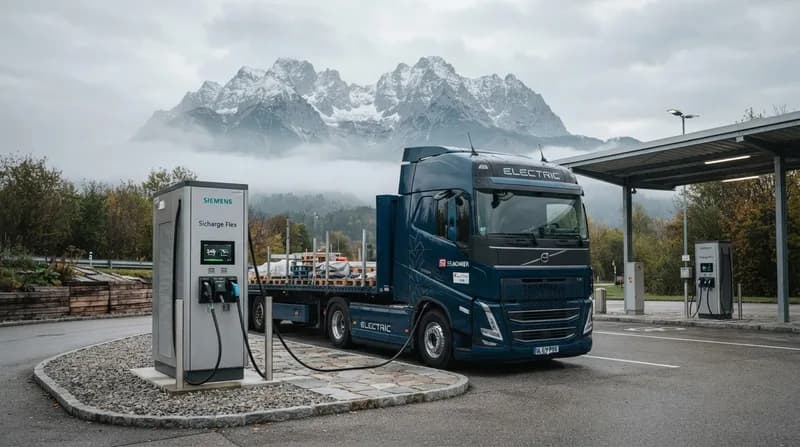
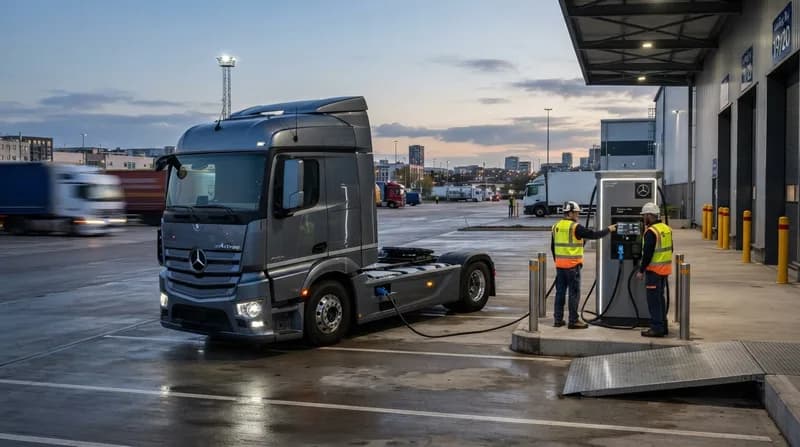
Beyond vehicle design, Mercedes-Benz Trucks is betting heavily on the Megawatt Charging System (MCS) to unlock the full potential of its electric fleet. Starting in 2027, the eActros 600 will be available with MCS capability, a technology that recent testing shows can exceed the one-megawatt power mark. For logistics operators, this changes the economics of transport; a truck can be fully recharged during the time it takes to unload a trailer and swap it for a new one.
By turning charging downtime into productive energy intake, MCS bridges the gap between limited range and infinite utility. This rapid-charging capability is considered a fundamental lever for the Lowliner, enabling the vehicle to remain in constant rotation without the long wait times traditionally associated with high-capacity battery systems.
A Dual-Track Strategy: Battery and Hydrogen
While battery-electric vehicles (BEV) are currently the primary focus for most routes, Mercedes-Benz Trucks maintains a dual-track strategy by continuing to develop the GenH2 fuel-cell truck. According to Michael Scheib, Head of Whole Vehicle Development, this strategy is essential for the transition of Europe’s six-million-strong truck fleet. The company views hydrogen as the optimal solution for ultra-long-distance transport that demands the highest payloads, where the weight of massive battery packs would otherwise become a limiting factor.
The company is currently scaling its hydrogen efforts, moving from a small initial test fleet to a 100-vehicle pilot program. The focus has now shifted from pure prototyping to industrialization, with an emphasis on cost optimization and series production readiness. By favoring liquid hydrogen, Mercedes-Benz aims to maximize range while simplifying the logistics of energy distribution compared to gaseous hydrogen storage. For the foreseeable future, the company sees a clear divide: battery-electric for standard, high-efficiency routes, and hydrogen for the extreme duty cycles that test the limits of modern energy density.
Why it Matters
- Infrastructure Constraints: The slow ramp-up of public charging networks necessitates a dual approach to ensure the industry meets 2030 sustainability goals.
- Economic Viability: Innovations like the Lowliner prove that electric trucks can match the cargo capacity of diesel, removing the final barriers for fleet operators.
- Energy Efficiency: Utilizing megawatt charging systems optimizes the balance between operational uptime and energy replenishment.
- Strategic Maturity: The shift toward industrializing fuel-cell technology indicates that hydrogen is moving from an experimental concept to a viable commercial asset.