E-BUZZ ME Logo
ScienceTechnical Deep Dive

Dogs Decode Human Emotions with Remarkable Accuracy

Published
Dogs Decode Human Emotions with Remarkable Accuracy
1 min read126 words

The Gist

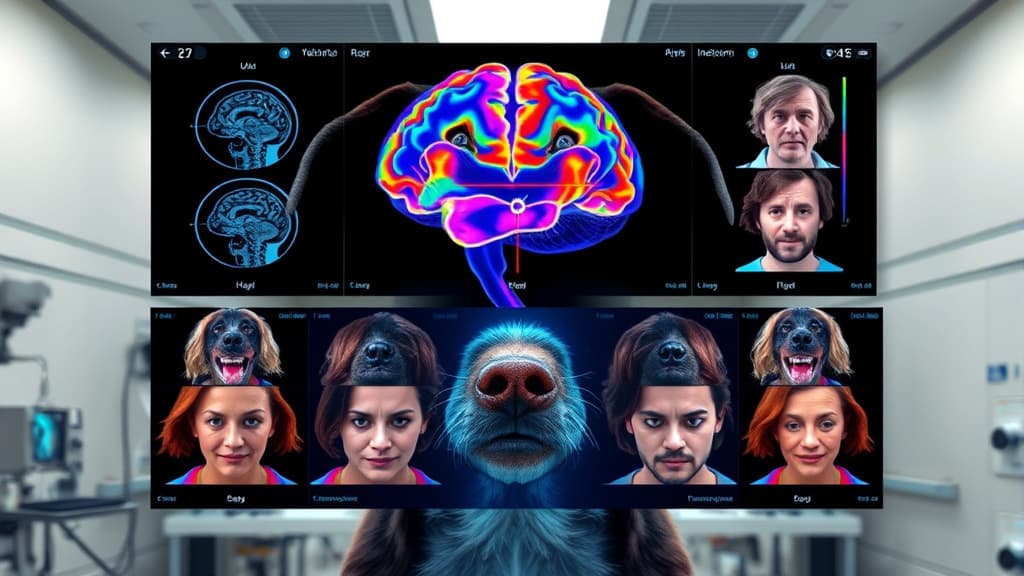
Researchers have made a groundbreaking discovery that dogs can distinguish between various human emotions, including happiness, anger, fear, and sadness, with their brains responding uniquely to each emotion. This finding was made possible through the use of brain scans that examined the neural activity of dogs as they viewed images of human faces expressing different emotions.

A recent study has shed light on the impressive ability of dogs to recognize and differentiate between various human emotions, a capability that has significant implications for our understanding of canine cognition and emotional intelligence. The research utilized brain scans to investigate how dogs process human facial expressions, revealing distinct patterns of neural activity in response to different emotions.

Key Insights

Dogs have been found to be adept at distinguishing between several negative human facial expressions, including anger, sadness, and fear. Furthermore, happy human faces elicit distinctive activity in specific regions of the canine brain. Notably, the brains of dogs respond differently to various emotions, with happiness triggering activity in areas associated with higher-level cognitive processing and reward, underscoring the complex nature of canine emotional processing.


Related Stories

Semantically matched articles, ranked by topic overlap and freshness.

Fusion Power Plants Get Economic Viability Metric
Science

Fusion Power Plants Get Economic Viability Metric

Researchers in the US have proposed a new metric, 'economic Q', to determine the economic viability of future fusion power plants. The metric includes 10 parameters to evaluate the economic viability of a fusion energy power plant, aiming to make fusion energy commercially viable in the marketplace.

Crystal Symmetry Controls Hydrogen's Quantum Tunnelling
Science

Crystal Symmetry Controls Hydrogen's Quantum Tunnelling

Researchers from the University of Tokyo have found that the degree of symmetry in a material's crystal structure determines whether hydrogen atoms follow quantum or classical physics, potentially allowing control over hydrogen's tunnelling ability. By tuning crystal symmetry, scientists could create safer and more efficient media for storing this clean-burning fuel, leading to breakthroughs in hydrogen storage and utilization.

Hospitals Use Wristbands to Help Reduce Childbirth Risks
Science

Hospitals Use Wristbands to Help Reduce Childbirth Risks

Hospitals across the US are using silicone wristbands to remind mothers and care providers of life-threatening health risks after birth, aiming to reduce maternal deaths and complications. The initiative has been adopted by nearly 50 hospitals and the state's health department, with other states and health systems also embracing the program.

150-million-year-old dinosaur footprints reveal strange walking pattern
Science

150-million-year-old dinosaur footprints reveal strange walking pattern

A 150-million-year-old trail of dinosaur footprints in Colorado has revealed a strange walking pattern, with the giant sauropod making a complete loop before continuing on its way. The footprints provide a unique insight into the behavior and movement of these prehistoric creatures, hinting at a possible limp due to an uneven stride.

BathMat Trial Shows Promise in Cutting ICU Workload
Science

BathMat Trial Shows Promise in Cutting ICU Workload

The BathMat, an inflatable repositioning device, has shown promise in reducing ICU workload while improving care for critically ill patients. The device has been found to reduce the number of staff required to reposition prone, ventilated patients from five to three, while saving an hour of staff time per repositioning exercise.

Math Could Stop the Next Pandemic, Not Borders
Science

Math Could Stop the Next Pandemic, Not Borders

Understanding complex networks and using math could help stop the next pandemic, rather than relying on closing borders, according to University of Virginia data science professor YY Ahn. By identifying the source of a disease outbreak and containing it before it spreads globally, math can play a crucial role in preventing widespread illness.

New Study Closes Critical Gap in Autism Therapy for Children
Science

New Study Closes Critical Gap in Autism Therapy for Children

A new study has developed the 'Schmetterling' Program, a therapeutic model for children with autism spectrum disorder, addressing interconnected symptoms. The program has shown promising results in a pilot study, with significant improvements in motor skills, reduced stress levels, and mitigation of autism symptoms.

Schizophrenia Risk May Be Identified Years Before Symptoms Appear
Science

Schizophrenia Risk May Be Identified Years Before Symptoms Appear

A study on children at increased risk of developing schizophrenia reveals subtle brain differences may emerge before symptoms appear, potentially allowing for early identification and intervention. The research analyzed the brains of 88 children ages 9 to 12, finding structural differences in brain tissue associated with schizophrenia risk factors.