The Quest for the Cosmic Dark Ages
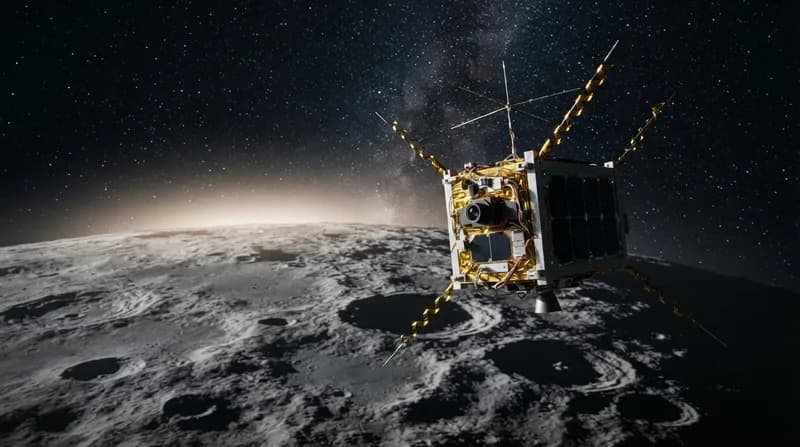
In a bold leap for space exploration, an international team led by the University of Cambridge is developing a small-scale satellite designed to pierce the veil of the universe's most mysterious era. Known as CosmoCube, the spacecraft is roughly the size of a carry-on suitcase, yet it is tasked with observing a period of history that has remained largely invisible to science: the 150 million years of darkness before the ignition of the very first stars.
The mission focuses on detecting the '21-centimeter line,' a faint radio signature emitted by hydrogen atoms during the epoch between the Big Bang's afterglow and the birth of the first celestial structures. Because this signal is incredibly weak and obscured by the constant radio chatter of Earth—including FM broadcasts, telecommunications, and atmospheric ionospheric interference—the research team has devised a clever orbital strategy to reach the only quiet place in our cosmic neighborhood: the far side of the Moon.
Utilizing the Lunar Shield
By positioning CosmoCube in a specific lunar orbit, the spacecraft will periodically slip behind the Moon, using the lunar body as a natural shield to block out Earth’s relentless radio noise. During these 40-minute windows of silence within every two-hour orbit, the satellite will deploy its specialized, lightweight radio antenna to listen for the faint echo of the early universe. This cycle of observation will be repeated over the course of a two-year mission, yielding approximately 1,000 hours of pure, interference-free data.
Detecting such a whisper from 13.5 billion years ago requires extreme precision. To ensure accuracy, the satellite is equipped with a 'Dicke switched' calibrator. This system continuously alternates between scanning the sky and measuring internal reference sources, allowing the mission hardware to identify and subtract its own electronic noise from the cosmic readings. Once the data reaches Earth, advanced Bayesian statistical analysis will further isolate the desired hydrogen signal from foreground galactic emissions.
Mission Objectives and Technology
- Targeted Observation: The mission seeks to capture radio frequencies between 10 and 50 MHz, a band effectively inaccessible to ground-based observatories.
- Dark Matter Insight: By analyzing how early hydrogen clumped together, researchers hope to better understand the role of dark matter in gravitational attraction and the subsequent formation of the first galaxies.
- Compact Innovation: The spacecraft utilizes advanced RF Systems on Chip (RFSoC) technology, integrating high-performance analog and digital hardware into a highly efficient, small-satellite platform developed by Surrey Space Technology Limited (SSTL).
- Cost-Effectiveness: With a projected mission cost under 50 million Euros, the project aims to prove that groundbreaking deep-space science does not necessitate the astronomical budgets typically associated with massive, flagship-class space observatories.
As competition for lunar orbit grows with interest from various space agencies worldwide, the CosmoCube team is moving swiftly to finalize development. With academic and industry partners across the UK and the EU—including Portsmouth University and STFC RAL Space—the mission represents a significant technological milestone. By leveraging miniaturized, highly specialized hardware, CosmoCube promises to turn the far side of the Moon into an unprecedented listening post for humanity, potentially rewriting our understanding of how the universe evolved from a dark, empty void into the complex structure of galaxies we inhabit today.