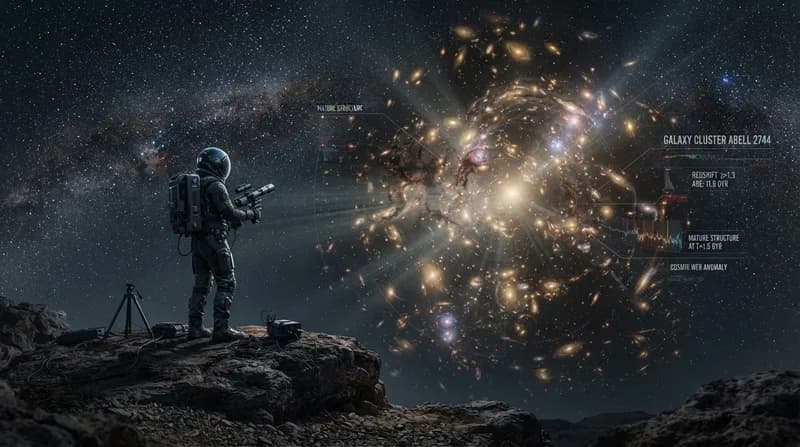
A Record-Breaking Discovery in the Early Universe
NASA’s James Webb Space Telescope (JWST) has turned its infrared gaze toward a distant cosmic behemoth, uncovering a galaxy cluster that is rewriting the textbooks on early universe evolution. Known as XLSSC 122, this massive structure is located roughly 10.4 billion light-years from Earth. It dates back to the era of 'cosmic noon,' a period characterized by intense star formation and the rapid assembly of cosmic structures. However, unlike other clusters observed from this epoch, XLSSC 122 appears far more advanced, organized, and densely packed than current cosmological models deem possible for its age.
This discovery centers on the phenomenon of strong gravitational lensing. While previous X-ray and Hubble observations confirmed the cluster's existence, the JWST provided the crucial data needed to identify the tell-tale arcs of warped light caused by the cluster's intense gravity. By acting as a cosmic magnifying glass, XLSSC 122 allows researchers to peer at even more distant galaxies behind it, providing an unprecedented laboratory for testing the distribution of invisible matter across the deep past.
Mapping the Invisible Through Intracluster Light
Beyond its sheer size, XLSSC 122 has provided a breakthrough in how astronomers map dark matter. By observing the 'intracluster light'—a diffuse, faint glow emanating from stars that have been stripped from their parent galaxies during violent cluster mergers—researchers found a striking correlation. The distribution of this ghostly starlight appears to map almost perfectly onto the distribution of dark matter within the cluster’s core.
This suggests that intracluster light could serve as a vital, visible proxy for tracking the invisible scaffolding of the universe. Because dark matter constitutes roughly five times the amount of ordinary matter, understanding its distribution is paramount to reconciling theory with reality. The ability to utilize this diffuse light as a diagnostic tool offers a new, powerful method for identifying how and when the universe began building its largest structures.
Why it Matters: Challenging the Standard Model
The findings from this study, spearheaded by researchers at Caltech’s IPAC, pose a significant headache for standard cosmological predictions. The primary issue lies in the concentration of mass within the cluster's center. Under existing theoretical frameworks, the growth of such massive, dense clusters should have been a gradual, multi-billion-year process. Finding such a 'mature' structure so shortly after the Big Bang suggests that the early universe may have been far more efficient at assembling matter than previously believed.
- Record-Setting Lens: XLSSC 122 is the most distant galaxy cluster confirmed to exhibit strong gravitational lensing.
- Cosmic Noon Focus: The cluster provides a window into the universe 10 billion years ago, a peak era for star production.
- Merger Dynamics: Multi-wavelength analysis confirms the cluster is still actively undergoing a major merger.
- New Diagnostic Tool: Intracluster light is now considered a potential key for mapping dark matter in distant, early clusters.
The Future of Cosmological Surveys
As the JWST era matures, the focus will shift from studying single, anomalous clusters to surveying large samples of these ancient structures. Lead researcher Kyle Finner and his team are looking toward wide-area surveys that leverage the Sunyaev-Zel'dovich effect—a method of identifying clusters through their interaction with the cosmic microwave background—to find more targets like XLSSC 122. If subsequent discoveries confirm that early universe clusters consistently display this high level of maturity, the scientific community may be forced to revisit the core tenets of structure formation models. For now, XLSSC 122 stands as a profound testament to the power of the James Webb telescope in unveiling the mysteries of our cosmic origins.