ScienceTechnical Deep Dive

Cosmic Breakthrough: CHIME Telescope Unlocks 9-Billion-Year-Old Hydrogen Signal

Published
EElectricBuzz Editorial Team
Cosmic Breakthrough: CHIME Telescope Unlocks 9-Billion-Year-Old Hydrogen Signal
3 min read497 wordsElectricBuzz Editorial Team

The Gist

“A Canadian radio telescope has successfully isolated an ancient hydrogen signature, providing a groundbreaking, cost-effective method to study dark energy and the history of our universe.”

A New Window into the Ancient Cosmos

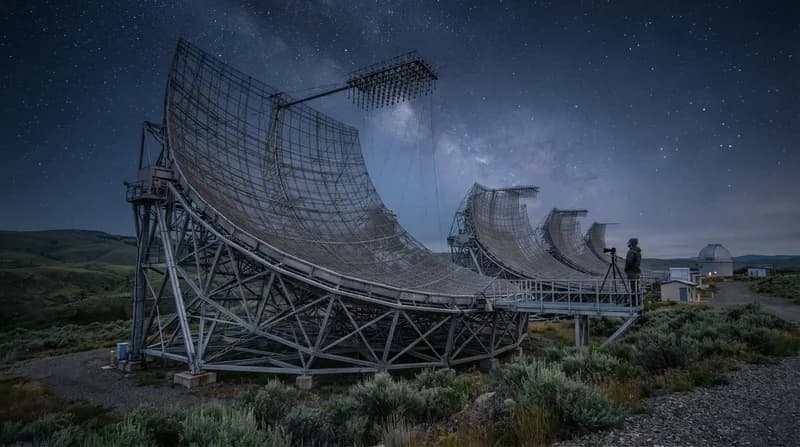
For years, one of the most persistent mysteries in physics has been the nature of dark energy—the enigmatic force currently accelerating the expansion of our universe. Now, researchers working with the Canadian Hydrogen Intensity Mapping Experiment (CHIME) have achieved a landmark breakthrough. By isolating the incredibly faint radio glow of hydrogen gas dating back nine billion years, the team has proven that it is possible to map the structure of the distant universe using only the telescope's internal data.

Located in Penticton, British Columbia, CHIME was designed specifically to chart the distribution of hydrogen, the universe's most abundant element. Unlike traditional galaxy surveys that focus on pinpointing individual, light-emitting structures, CHIME detects the collective radio emissions of hydrogen gas. This methodology allows scientists to visualize the distribution of matter across vast cosmic expanses, providing a clearer picture of how the universe has evolved over billions of years.

Why it Matters

  • Cost-Effective Mapping: By eliminating the need to cross-reference data with expensive, traditional galaxy surveys, this technique significantly reduces the financial and logistical barriers to cosmological research.
  • Dark Energy Insights: The ability to track the large-scale distribution of hydrogen offers a powerful, independent tool to test competing theories about how dark energy shapes cosmic expansion.
  • Galactic Evolution: Beyond dark energy, the data provides a new mechanism to verify models of how galaxies form, grow, and aggregate within the cosmic web.

Overcoming Cosmic Noise

The path to this discovery was far from simple. Detecting a signal from nine billion years ago is akin to finding a whisper in the middle of a hurricane. The research team had to develop sophisticated data-processing algorithms to scrub out interference from human technology, local radio noise, and internal telescope artifacts. After identifying a potential candidate, the team spent an entire year subjecting the data to rigorous testing to ensure the finding was a genuine relic of the early universe rather than a measurement error.

The successful detection, based on a massive dataset of 94 nights of observations from 2019, represents only a tiny fraction of the information CHIME has collected since its inception. Researchers are now turning their attention to the nearly seven years of additional data currently available. Their ambitious goal is to extend this mapping technique even further back in time, potentially reaching an era when the universe was just three billion years old.

The Future of CHIME

This achievement cements CHIME's status as a pivotal instrument in modern astrophysics. By proving that the telescope can function as a standalone mapping machine, the researchers have effectively opened a new chapter in cosmology. This "Canadian success story," as described by principal investigator Dr. Mark Halpern, provides the global scientific community with a versatile tool to challenge existing physics models. As the team continues to refine their analysis, the international community waits to see if these ancient signals will finally resolve the long-standing debate over the mysterious, dark mechanisms that govern the destiny of our universe.

SPONSORED
The 5 Best Over-Ear ANC Headphones of 2026, Tested & Ranked
Editor's Pick Guide
92/100
Tech & Gadgets•12 min read

The 5 Best Over-Ear ANC Headphones of 2026, Tested & Ranked

We locked five over-ear ANC picks for 2026 — Sony WH-1000XM6, Bose QuietComfort Ultra 2, Soundcore Space One, Sennheiser Momentum 5, and Apple AirPods Max 2 — then stress-tested them on lab metrics, long-term owner truth, and live street prices.

Related Stories

Semantically matched articles, ranked by topic overlap and freshness.

Why High-Intensity Training Is a Secret Weapon for Healthy Aging
Science

Why High-Intensity Training Is a Secret Weapon for Healthy Aging

A groundbreaking study reveals that for older adults, the secret to shedding fat while preserving vital muscle mass may lie in short, intense bursts of exercise.

Bacterial Immune Systems Reveal a Hidden 'Trojan Horse' Defense Mechanism
Science

Bacterial Immune Systems Reveal a Hidden 'Trojan Horse' Defense Mechanism

A groundbreaking discovery at the University of Utah reveals how bacteria use a virus's own proteins as a tripwire to trigger a lethal, self-sacrificing immune response.

Beyond the Final Product: Scientists Uncover 'Hidden' Materials for a Green Energy Revolution
Science

Beyond the Final Product: Scientists Uncover 'Hidden' Materials for a Green Energy Revolution

Researchers have discovered a new way to identify previously unknown materials by examining the 'in-between' phases of chemical synthesis, potentially unlocking breakthroughs for batteries and solar fuels.

Biological Time Travel: Scientists Successfully Reverse Cellular Age by Six Decades
Science

Biological Time Travel: Scientists Successfully Reverse Cellular Age by Six Decades

Researchers at the University of Bonn have achieved a breakthrough in cellular reprogramming, transforming blood cells from an 80-year-old donor into neural stem cells with a biological age of under 20.

Return from the Final Frontier: NASA’s Crew-12 Completes Historic 237-Day Mission
Science

Return from the Final Frontier: NASA’s Crew-12 Completes Historic 237-Day Mission

After logging over 100 million miles in orbit, the SpaceX Crew-12 astronauts have safely splashed down, bringing home vital research for future Moon and Mars expeditions.

The 20-Minute Gut Reset: How Walking Rapidly Stimulates Digestive Motility
Science

The 20-Minute Gut Reset: How Walking Rapidly Stimulates Digestive Motility

New research from Fujita Health University confirms that a short, comfortable walk can trigger immediate, measurable increases in intestinal movement, providing a physiological basis for exercise-induced constipation relief.

Bridging the Gap: How Digital Health Expectations Reshape Nursing Practices
Science

Bridging the Gap: How Digital Health Expectations Reshape Nursing Practices

A recent study from the University of Eastern Finland explores how the anticipation of future digital efficiencies is currently transforming the day-to-day reality of clinical nursing.

Sonic Relief: How Your Personal Playlist Can Reduce Clinical Pain
Science

Sonic Relief: How Your Personal Playlist Can Reduce Clinical Pain

New research suggests that listening to your own favorite music may significantly outperform traditional relaxation tracks during minor medical procedures like cannula insertion.