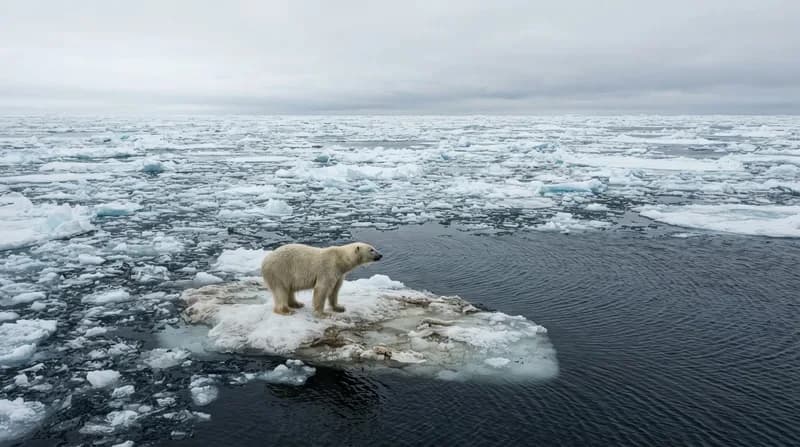
The Shifting State of the Arctic
The Arctic, once a region defined by thick, perennial ice that persisted through the warmest months, is undergoing a profound and troubling transformation. Data compiled by NASA and the National Snow and Ice Data Center (NSIDC) reveals that the 2026 September minimum extent reached approximately 4.6 million square kilometers, tying for the 10th-lowest level since satellite monitoring began in 1978. This event is not an isolated anomaly but part of a persistent trend that highlights the vulnerability of the region to rising global temperatures.
While the rate of ice loss showed a temporary period of relative stability over the past decade—aided partly by increased cloud cover reflecting sunlight away from the surface—the underlying trajectory remains clear. The seasonal cycle, which has balanced freezing winters and melting summers for millennia, is being disrupted by a climate system that is increasingly incapable of regenerating the ice volume lost during the summer months.
The Decline of Multiyear Ice
A critical metric beyond mere surface area is ice thickness and age. Historically, the Arctic was dominated by "multiyear ice," which survives multiple summer melt seasons, gaining density and structural resilience over time. Today, this resilient foundation is disappearing. The Arctic is increasingly characterized by "first-year ice," a thin, fragile layer that forms and melts with greater speed. This youthfulness leaves the remaining ice cap far more susceptible to the mechanical stress of shifting winds and the thermodynamic pressure of warmer ocean currents.
This thinning is not confined to the summer melt season. In March 2026, the Arctic reached its annual peak with one of the lowest winter maximums ever recorded, effectively tying the record low set in 2025. This indicates that even during the coldest, darkest months when the system should be resetting, the Arctic is failing to regain its historical mass.
Why it Matters: The Road to an Ice-Free Arctic
- Near-Term Projections: Scientists are now warning that the Arctic could experience a nearly ice-free summer—defined as having less than 1 million square kilometers of ice—before the middle of the century.
- Feedback Loops: As bright, reflective ice is replaced by dark, heat-absorbing open ocean, the region’s ability to regulate global temperatures is severely compromised.
- Technological Monitoring: The use of passive microwave sensors on satellites like NASA’s Nimbus-7 and the GCOM-W spacecraft allows researchers to track these changes through cloud cover and storms, providing a continuous, high-fidelity view of the changing North Pole.
The Technological Eye in the Sky
To monitor these shifts, researchers rely on sophisticated microwave radiometry. Unlike standard optical cameras that are frequently blinded by the Arctic's near-constant cloud cover, passive microwave sensors detect energy emitted from the Earth's surface. Because sea ice and liquid seawater emit microwave energy at distinct levels, satellites can create accurate, daily maps of the ice extent regardless of weather or visibility. This technological capability has provided nearly 50 years of consistent, uninterrupted data, turning the Arctic into the world’s most monitored climate laboratory.
As these sensors continue to beam data down to Earth, the findings present a sobering picture. While natural cycles like the Arctic Oscillation influence year-to-year variability, they cannot explain the persistent, long-term decline observed since the late 1970s. As we move closer to mid-century, the evidence confirms that human-driven climate change is the primary architect of a future Arctic that may soon be unrecognizable compared to its recent past.