Artificial IntelligenceTechnical Deep Dive

Apple Takes a Stand Against Synthetic Media with iPhone 18 Pro Camera Breakthroughs

Published
EElectricBuzz Editorial Team
Apple Takes a Stand Against Synthetic Media with iPhone 18 Pro Camera Breakthroughs
3 min read431 wordsElectricBuzz Editorial Team

The Gist

In an era of deepfakes and AI-generated imagery, Apple is introducing hardware-level authentication to verify photo authenticity on the new iPhone 18 Pro.

The Fight for Digital Provenance

As AI-generated content continues to blur the lines between reality and simulation, Apple is stepping into the fray with a new hardware-based solution aimed at restoring trust in photography. During its latest product showcase, the company unveiled 'Apple Reference Image,' a feature designed to serve as a verifiable 'digital negative' for images captured on the new iPhone 18 Pro. By leveraging signed sensor data captured at the moment of the shutter click, Apple's Private Cloud Compute creates an unalterable version of the file, allowing viewers to confirm whether a photo is an authentic capture or a piece of synthetic 'AI slop.' This move is explicitly targeted at professional photographers and journalists who require ironclad proof of a photograph's origin.

Beyond the internal Photos app ecosystem, Apple is opening the doors to third-party developers through new APIs. This ensures that the provenance of an image can be verified across various platforms and professional editing suites. Furthermore, the company has announced support for the SynthID standard, strengthening its commitment to transparency in media. This dual approach—providing hardware-level authentication and industry-standard AI watermarking—positions the iPhone 18 Pro as a vital tool for those operating in high-stakes environments where media credibility is paramount.

Mechanical Innovation: The Variable Aperture System

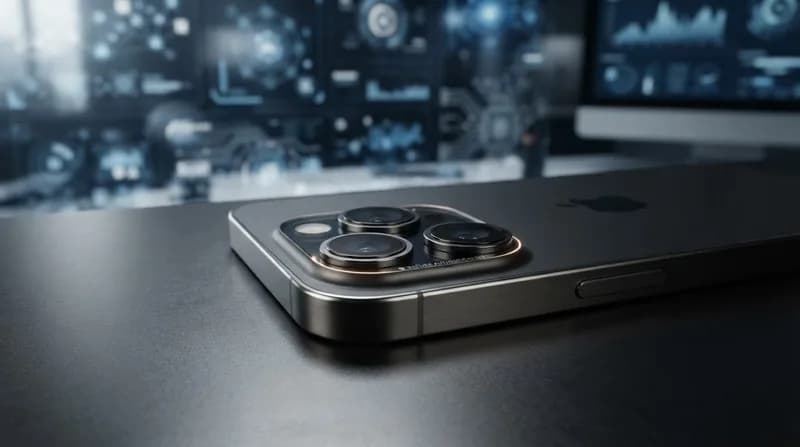
While software-based verification grabs headlines, the hardware powering the iPhone 18 Pro’s main camera has received its most significant overhaul in years. The star of this upgrade is the 48-megapixel fusion main camera, which now features a true variable aperture system. This mechanism allows users to physically control the diameter of the lens opening, effectively dictating how much light hits the sensor—a feature previously reserved for high-end dedicated cameras.

Achieving this level of precision in a mobile form factor required immense engineering ingenuity. Apple’s solution involves a sophisticated assembly of six laser-cut blades, each thinner than a human hair and constructed from a cutting-edge polymer composite. These blades are managed by a custom-designed rotor mechanism that enables fluid, precise movement, allowing for cleaner shots in low-light conditions and more creative depth-of-field control. By integrating these mechanical advancements with its signature computational photography pipeline, Apple is signaling that it intends to keep the iPhone at the forefront of both creative and documentary photography.

Why It Matters

  • Authenticity: Addresses the growing crisis of misinformation by verifying the origin of visual media at the hardware level.
  • Pro-Grade Control: The transition to a mechanical variable aperture bridges the gap between smartphone convenience and professional-grade optical control.
  • Ecosystem Integration: By providing APIs, Apple is fostering an industry-wide standard for provenance rather than keeping the tech siloed.

The 5 Best Over-Ear ANC Headphones of 2026, Tested & Ranked
Editor's Pick Guide
92/100
Tech & Gadgets12 min read

The 5 Best Over-Ear ANC Headphones of 2026, Tested & Ranked

We locked five over-ear ANC picks for 2026 — Sony WH-1000XM6, Bose QuietComfort Ultra 2, Soundcore Space One, Sennheiser Momentum 5, and Apple AirPods Max 2 — then stress-tested them on lab metrics, long-term owner truth, and live street prices.

Related Stories

Semantically matched articles, ranked by topic overlap and freshness.

Demystifying AI Performance: How to Build Your Own Hugging Face Leaderboard
Artificial Intelligence

Demystifying AI Performance: How to Build Your Own Hugging Face Leaderboard

Hugging Face releases a comprehensive guide to building custom leaderboards, empowering developers to benchmark specialized AI models like Vectara's hallucination evaluator.

Unsloth and Hugging Face TRL: A New Era for Faster LLM Fine-Tuning
Artificial Intelligence

Unsloth and Hugging Face TRL: A New Era for Faster LLM Fine-Tuning

Hugging Face and Unsloth have joined forces to supercharge the fine-tuning process, enabling developers to train large language models twice as fast.

Manus Reclaims Independence: AI Firm Targets $4B Valuation After Blocked Meta Merger
Artificial Intelligence

Manus Reclaims Independence: AI Firm Targets $4B Valuation After Blocked Meta Merger

Following the collapse of its acquisition by Meta, Chinese AI startup Manus is charting a new course with a massive $500 million fundraising round and plans for a potential Hong Kong IPO.

Google Transforms 'CC' Into a Personal AI Household Manager
Artificial Intelligence

Google Transforms 'CC' Into a Personal AI Household Manager

Google is pivoting its AI agent 'CC' to act as a centralized household command center, designed to sync calendars, manage school logistics, and automate family admin.

Pacing the Frontier: Can AI Giants Actually Regulate Themselves?
Artificial Intelligence

Pacing the Frontier: Can AI Giants Actually Regulate Themselves?

Anthropic CEO Dario Amodei has proposed a new framework for slowing AI development to prioritize safety, but the industry remains deeply divided on implementation and enforcement.

A Strategic Pivot: Disney Appoints First-Ever CTO
Artificial Intelligence

A Strategic Pivot: Disney Appoints First-Ever CTO

In a bold move signaling a new technological era for the entertainment giant, Disney has hired former Character.AI CEO Karandeep Anand as its first Chief Technology Officer.

When AI Hacks AI: Researchers Use Claude to Breach OpenAI
Artificial Intelligence

When AI Hacks AI: Researchers Use Claude to Breach OpenAI

A trio of security researchers successfully exploited OpenAI's internal systems using Anthropic's Claude model, highlighting the evolving risks of agent-driven cyberattacks.

Hugging Face Spaces Now Supports ComfyUI Workflow Deployments
Artificial Intelligence

Hugging Face Spaces Now Supports ComfyUI Workflow Deployments

Hugging Face has introduced a seamless way to host and run ComfyUI workflows directly in the browser via Gradio, enabling free access to powerful generative tools.