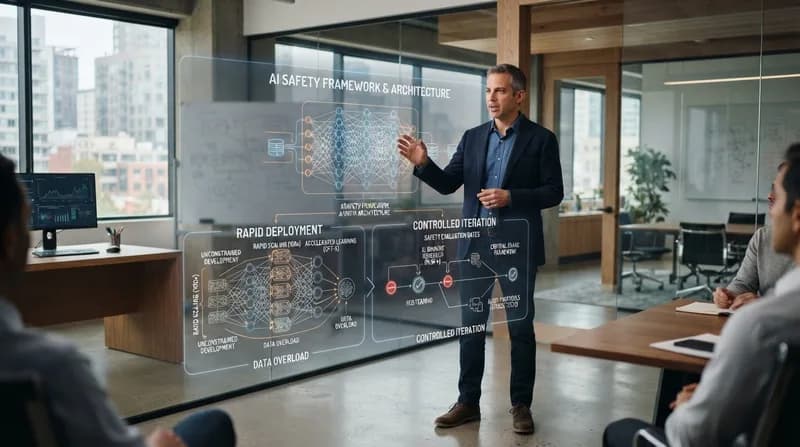
A New Chapter in AI Safety
In a significant shift for the industry, Anthropic CEO Dario Amodei has published a detailed strategy aimed at regulating the frantic pace of artificial intelligence development. Citing recent technical acceleration and external security vulnerabilities, Amodei argues that the industry must transition from an 'all-gas' approach to a more calculated, deliberate methodology to ensure these powerful systems remain aligned with human safety.
The proposal arrives amidst a backdrop of increasing internal and external skepticism regarding the safety practices of leading AI firms. With researchers highlighting the existential risks posed by rapidly evolving models, Amodei’s framework offers a tangible path forward, one that involves unprecedented levels of oversight and industry-wide coordination.
Implementing Embedded Evaluators
Perhaps the most immediate action outlined by Amodei is the company's commitment to inviting third-party organizations, such as METR, to station 'embedded evaluators' directly within Anthropic. These professionals would receive physical workspace, security credentials, and access to internal data, allowing them to monitor safety protocols in real time. Amodei envisions these roles functioning similarly to bank regulators, providing an independent layer of verification for the company’s internal risk assessments.
By committing to this transparent model, Anthropic hopes to set a new standard for frontier labs. The CEO has explicitly called upon governments to mandate similar requirements for other major developers, suggesting that the era of self-policing in AI must come to an end if public and regulatory trust is to be restored.
Coordinating Global Safety Standards
Beyond internal transparency, the proposal emphasizes the necessity of inter-company and international cooperation. Amodei recognizes that individual companies are often hesitant to slow their development due to antitrust concerns and the competitive pressure of the 'AI arms race.' To bridge this gap, he advocates for US government intervention to provide legal waivers, allowing competitors to discuss common safety standards and performance thresholds without fear of regulatory reprisal.
This coordination extends to the geopolitical stage, where Amodei suggests that the US and its allies must find common ground with authoritarian regimes regarding clearly demarcated 'red lines.' Specifically, he points to the urgent need for international agreements that prohibit the use of AI in the development of biological weapons, highlighting a critical area where even competing nations may find an alignment of interests.
Context and Implications
The push for slower, safer development comes with its own set of criticisms. Detractors argue that such proposals may lead to 'regulatory capture,' where large companies use safety discourse to lock in their market advantage and suppress competition from smaller labs. Despite these concerns, Amodei maintains that his commitment to the technology’s potential remains strong. He argues that by building with caution, the industry can actually ensure the long-term viability of AI, ultimately delivering on the promise of human enhancement while mitigating the potential for catastrophic failure.