A New Frontier in Atmospheric Sensing
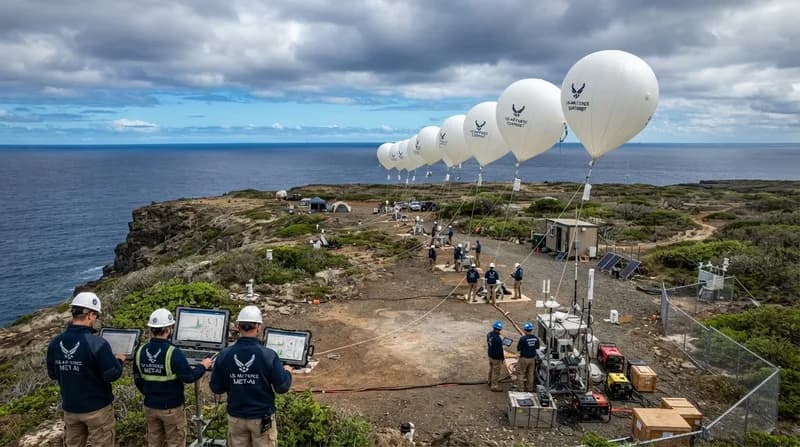
In a major development for meteorological technology, the U.S. Air Force has awarded Redwood City-based startup WindBorne Systems a contract worth up to $49 million. The agreement signals a significant shift in how the military approaches weather intelligence, moving away from reliance solely on traditional ground-based stations and conventional satellites toward a high-frequency, autonomous network of weather balloons. With approximately 700 units currently deployed globally, WindBorne’s fleet acts as a persistent sensory net, providing real-time data that is critical for tactical operations and long-range environmental analysis.
The contract operates on an on-demand basis, allowing the Air Force to procure specific atmospheric data for localized regions precisely when and where it is needed. While the total potential value reaches nearly $50 million, the current initial order stands at $1.7 million, with expectations that this figure will grow as the military integrates WindBorne’s unique data stream into its standard operating procedures. The deal was awarded without competitive bidding, as the government determined that WindBorne’s specific capability for collecting global, high-resolution data in this manner was currently unmatched by any other provider.
The Intersection of AI and Meteorological Hardware
WindBorne is distinct from traditional atmospheric hardware firms because it integrates its physical sensor network directly with its proprietary deep-learning model, WeatherMesh 6. While legacy models rely primarily on complex physical equations processed by massive supercomputers, WindBorne’s approach utilizes transformer architecture to ingest decades of climate data. This transition to AI-driven forecasting has allowed the company to generate predictions that frequently outperform established benchmarks, such as those produced by the European Centre for Medium-Range Weather Forecasts.
The hardware itself is a marvel of efficiency and autonomous navigation. Unlike traditional weather balloons that drift aimlessly with wind currents, WindBorne’s systems are "unpowered," yet highly maneuverable. By adjusting their altitude, bleeding internal air, or dropping ballasted sand, the balloons can navigate specific wind currents to reach target locations. This capability was famously demonstrated in August when the company successfully directed a balloon into the eye of a typhoon to collect rare, high-fidelity data—an operational milestone for unpowered atmospheric sensing.
Why it Matters
- Scalability: The Air Force contract provides the necessary financial runway to grow the balloon constellation, improving global coverage and data density.
- AI Operationalization: This partnership represents one of the first times a deep-learning forecasting model has been used to make active, mission-critical operational decisions.
- Cost Efficiency: By utilizing autonomous, low-cost balloons instead of multi-million dollar satellites or manned reconnaissance flights, the government achieves higher temporal resolution at a fraction of the cost.
- Technological Independence: The ability to maneuver these units provides a unique data-collection advantage that is physically impossible for conventional weather balloon deployments.
As the company continues to refine its WeatherMesh models and enhance its balloon hardware, the long-term goal remains clear: creating the world’s most precise, real-time atmospheric observation network. For the U.S. Air Force, the contract is a strategic investment in the future of predictive weather intelligence, ensuring that military decision-makers have access to data that is as dynamic and unpredictable as the atmosphere itself.