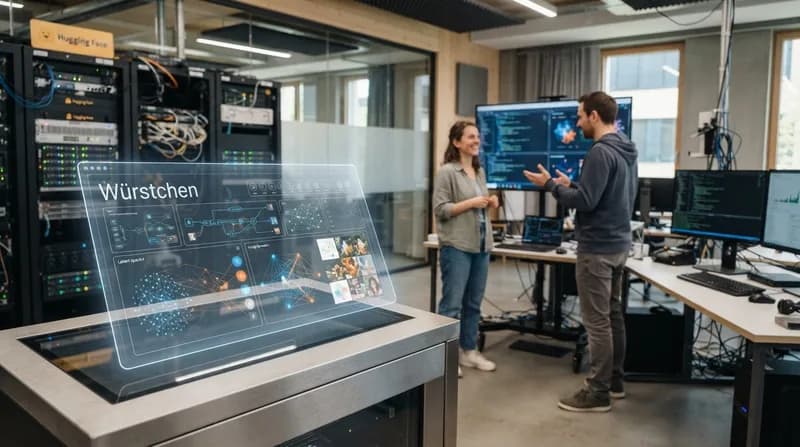
Revolutionizing Diffusion Speed
The landscape of generative AI is shifting toward efficiency, and the newly released Würstchen model represents a major leap forward in image synthesis. Unlike traditional Latent Diffusion Models (LDMs) that process data at high resolutions, Würstchen employs a unique 'text-conditional image generator' architecture that compresses data into a much smaller latent space. By operating on this highly compressed representation, the model achieves unprecedented speeds during the inference phase.
The Core Innovation
At its heart, the architecture utilizes a three-stage process. First, it compresses images significantly, which drastically reduces the computational burden on the GPU. Second, the model performs the bulk of the diffusion process within this compact latent space. Finally, a decoder restores the compressed representation into a high-quality, high-resolution image. This decoupling of the diffusion process from high-pixel-count manipulation allows Würstchen to outperform many legacy models on standard consumer hardware.
Why It Matters
- Efficiency: By reducing the memory footprint, the model enables faster image generation on less powerful hardware.
- Scalability: The approach demonstrates that complex visual tasks can be solved by smarter latent representations rather than just larger model parameters.
- Accessibility: Lower compute requirements mean that high-quality generative AI is no longer restricted to those with top-tier enterprise clusters.
As AI developers continue to push the boundaries of creative tooling, the shift toward models like Würstchen signifies a move away from brute-force computation. By prioritizing intelligent latent space design, this model proves that the future of generative media is not just about producing better results, but producing them faster and more sustainably. This development is a pivotal win for both researchers looking to optimize pipelines and end-users seeking immediate, high-resolution visual output without the wait time associated with older diffusion architectures.