Artificial IntelligenceTechnical Deep Dive

Unlocking Enterprise Control: The Rise of SafeCoder

Published
EElectricBuzz Editorial Team
Unlocking Enterprise Control: The Rise of SafeCoder
2 min read328 wordsElectricBuzz Editorial Team

The Gist

“Data privacy concerns are pushing enterprises toward open-weight solutions like SafeCoder as an alternative to black-box coding assistants.”

The Shift Toward Open Transparency

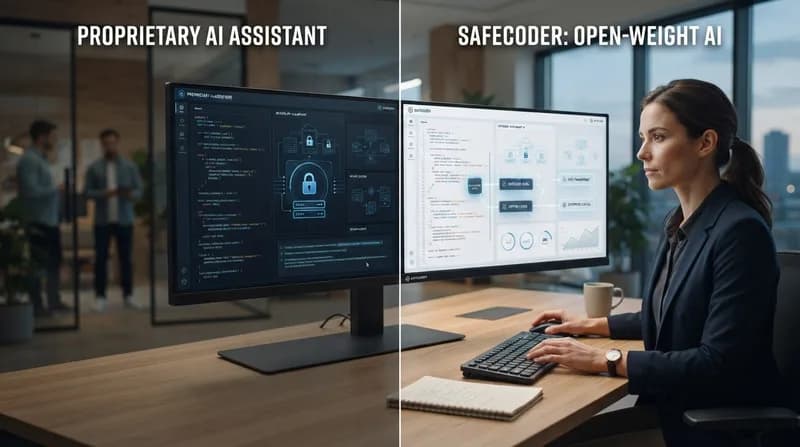
In the rapidly evolving landscape of AI-assisted software development, the tension between closed-source black-box models and open-weight alternatives has reached a critical inflection point. Enterprises are increasingly moving away from proprietary coding tools that send sensitive internal repositories to external servers. SafeCoder has emerged as a direct response to these security and intellectual property challenges, offering a transparent, self-hosted infrastructure that keeps corporate intellectual property firmly behind the firewall.

Why it Matters

The primary concern for modern engineering teams is the risk of data leakage. Closed-source assistants, while convenient, often lack the granular control required by regulated industries. SafeCoder bridges this gap by allowing companies to leverage advanced large language models without the necessity of sharing their proprietary codebase with third-party service providers. This autonomy is essential for firms dealing with sensitive financial data, healthcare records, or critical infrastructure.

  • Data Sovereignty: All operations occur within the client's internal environment, ensuring that proprietary data never leaves the premises.
  • Customization: Unlike rigid closed-source models, the open nature of these tools allows for fine-tuning on domain-specific documentation and internal coding standards.
  • Cost Efficiency: By avoiding per-seat licensing fees inherent in many commercial offerings, businesses can optimize their long-term operational expenditures.
  • Security Audits: Organizations can conduct full internal audits of the model architecture, providing a level of assurance that third-party vendors simply cannot match.

As the industry matures, the value proposition of SafeCoder lies not just in the performance of its 16B parameter models, but in the trust it fosters. By shifting from a service-based model to a self-managed infrastructure, developers are regaining control over the software development lifecycle. This paradigm shift suggests that the future of enterprise AI will prioritize auditability and security just as highly as the raw predictive capabilities of the underlying models themselves. As teams look to integrate AI deeper into their CI/CD pipelines, the ability to maintain a strictly controlled deployment environment will likely become the standard for large-scale enterprise software development.


The 5 Best Over-Ear ANC Headphones of 2026, Tested & Ranked
Editor's Pick Guide
92/100
Tech & Gadgets•12 min read

The 5 Best Over-Ear ANC Headphones of 2026, Tested & Ranked

We locked five over-ear ANC picks for 2026 — Sony WH-1000XM6, Bose QuietComfort Ultra 2, Soundcore Space One, Sennheiser Momentum 5, and Apple AirPods Max 2 — then stress-tested them on lab metrics, long-term owner truth, and live street prices.

Related Stories

Semantically matched articles, ranked by topic overlap and freshness.

LiquidAI Debuts LFM2.5-VL-DSpark: A New Frontier in Compact Vision-Language Models
Artificial Intelligence

LiquidAI Debuts LFM2.5-VL-DSpark: A New Frontier in Compact Vision-Language Models

LiquidAI introduces LFM2.5-VL-DSpark, a lightweight yet potent 3B parameter model engineered to push the boundaries of real-time vision-language processing.

Optimizing Large Language Models: A Guide to Quantization Schemes
Artificial Intelligence

Optimizing Large Language Models: A Guide to Quantization Schemes

Navigating the trade-offs between bitsandbytes and AutoGPTQ for efficient model deployment and fine-tuning.

Meta’s Muse Charm: Merging AI Utility with the Gen Z Accessory Craze
Artificial Intelligence

Meta’s Muse Charm: Merging AI Utility with the Gen Z Accessory Craze

Meta is betting that AI doesn't have to live solely in your smartphone, introducing the Muse Charm as a wearable, customizable AI companion that doubles as a fashion statement.

Google Unveils 'Call for Me': Letting Gemini Handle Your Mundane Phone Calls
Artificial Intelligence

Google Unveils 'Call for Me': Letting Gemini Handle Your Mundane Phone Calls

Google is testing a new AI-powered feature for Pixel 11 users that allows Gemini to navigate phone menus, wait on hold, and communicate directly with businesses on your behalf.

ElevenLabs Hits $22 Billion Valuation as Voice AI Revolutionizes Enterprise
Artificial Intelligence

ElevenLabs Hits $22 Billion Valuation as Voice AI Revolutionizes Enterprise

Four years after its inception, ElevenLabs has surged to a $22 billion valuation, cementing its role as the industry standard for AI-driven voice technology and synthetic speech.

Ubuntu Accelerates Kernel Updates to Combat AI-Powered Vulnerability Explosion
Artificial Intelligence

Ubuntu Accelerates Kernel Updates to Combat AI-Powered Vulnerability Explosion

Canonical is moving Ubuntu to a weekly kernel release cycle as AI-driven security researchers uncover bugs faster than traditional update schedules can handle.

YouTube Supercharges Creator Studio with Generative AI and Data Insights
Artificial Intelligence

YouTube Supercharges Creator Studio with Generative AI and Data Insights

YouTube is rolling out a suite of powerful AI-driven tools within its Studio app designed to streamline content strategy, optimize thumbnails, and provide actionable feedback on video drafts.

Optimizing Large Language Model Training with PyTorch FSDP
Artificial Intelligence

Optimizing Large Language Model Training with PyTorch FSDP

A new technical guide reveals how developers can efficiently fine-tune the powerful Llama 2 70B model using PyTorch Fully Sharded Data Parallelism.