A Call for Cosmic Creativity
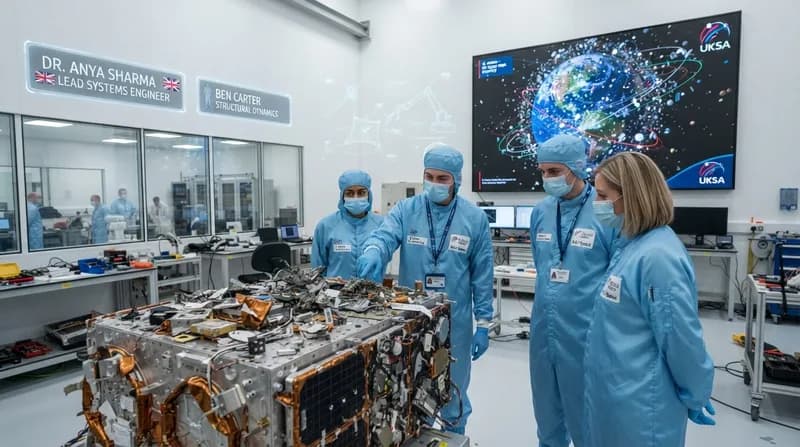
In a bold move to engage the public in the future of orbital sustainability, the UK Space Agency has officially invited citizens to suggest a name for its upcoming Active Debris Removal Mission. While the official title of the operation currently lacks a catchy ring, the government hopes that a bit of public ingenuity will result in a moniker worthy of a historic mission. The chosen name will not only represent the project but will actually be etched directly onto the side of the spacecraft, serving as a permanent mark of this ambitious environmental initiative.
The agency, in partnership with ClearSpace UK, has laid out strict guidelines for potential entries. Participants are asked to submit a two-word name along with a 150-word justification explaining how the choice reflects the mission’s core goal of cleaning up Earth's orbit. To ensure the final branding remains professional, the agency has explicitly banned profanity, political statements, and anything that might trigger intellectual property disputes—a clear nod toward avoiding the infamous internet-driven naming fiascos of the past.
The Mission: A Orbital Sanitation Service
The cleanup project, backed by over £60 million in government funding, is designed to target two defunct UK-registered satellites currently cluttering Low Earth Orbit. The primary objective is to demonstrate that human-made debris can be safely retrieved rather than left to wander the stars indefinitely. The mission is scheduled for a 2029 launch from the SaxaVord Spaceport in Scotland, with an ambitious target to complete the disposal operations by 2032.
The engineering involved is remarkably sophisticated. The spacecraft is designed to perform a complex dance in space: identifying, approaching, and capturing a satellite that was never originally designed to be grabbed. Once secured, the spacecraft will drag the debris into a lower orbit to ensure it burns up harmlessly during atmospheric reentry. Because the vehicle is designed to be refuellable, it is capable of climbing back to a higher orbit to repeat the process, essentially becoming a multi-use orbital garbage truck.
Why It Matters
- Orbital Sustainability: With low Earth orbit becoming increasingly crowded, the ability to remove defunct hardware is essential to prevent collisions that could trigger a cascade of space debris.
- Technological Milestone: Developing the capability to capture uncooperative, non-maneuverable objects is a major leap forward for future space infrastructure and servicing missions.
- Public Engagement: By crowdsourcing the name, the UK Space Agency is attempting to bridge the gap between complex aerospace engineering and public consciousness, fostering a greater national interest in space science.
As industry veterans look toward the 2029 target date, the focus remains firmly on the technical execution. Rob Atchison, Managing Director of ClearSpace UK, emphasized the extreme difficulty of the task, noting that the spacecraft must learn to control objects that were never intended to be handled. While other ventures have attempted similar capture missions with mixed results, this UK-backed initiative hopes to set the standard for a cleaner, safer orbital environment for generations to come.