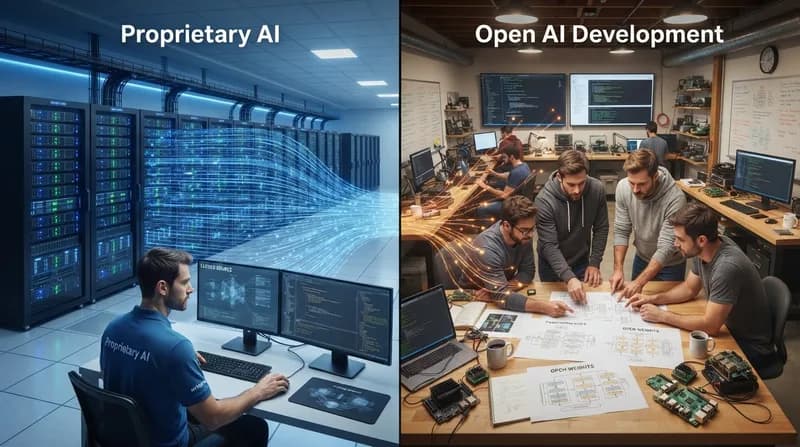
The Shift Toward Open-Weight Dominance
The landscape of artificial intelligence is undergoing a significant transformation. Recent data from Vercel’s AI Gateway—a platform that facilitates access to various AI models through a unified interface—indicates that open-weight models have officially surged to the forefront of industry adoption. As of September, these models are now handling a staggering 71.5 percent of all gateway token volume, reflecting a clear preference among developers for models that offer more transparency and localized control compared to strictly proprietary alternatives.
This shift is not merely academic; it is reflected in the financial data. While open-weight models initially accounted for only a tiny fraction of spending, their share of gateway expenditures has quadrupled over a single three-month period. In June, these models represented just one in twenty gateway dollars, but by September, they commanded nearly one in four. This surge suggests that businesses are rapidly finding value in non-proprietary architectures, moving away from the vendor lock-in that has traditionally dominated the AI sector.
Understanding the AI Gateway Market
The Vercel AI Gateway acts as a critical barometer for industry trends. By aggregating demand across a wide array of enterprise and hobbyist projects, the platform highlights how developers are experimenting with different providers. The market is becoming increasingly fluid; Vercel noted that nearly one in three teams switched their primary AI provider in September alone. This competitive pressure is forcing major AI vendors to innovate more quickly and aggressively manage costs.
Interestingly, the data shows that high token volume does not always equate to the highest revenue. For instance, the newly released TypeSafe AI Jev model gained rapid popularity, reaching 35 percent of paid teams within just two weeks of launch. Despite this massive footprint in terms of adoption, it accounted for only 1 percent of token volume and a marginal 0.15 percent of spending, highlighting how lightweight, specialized models can provide outsized utility without the massive overhead associated with general-purpose, large-scale LLMs.
Why It Matters
- Vendor Agnostic Architectures: The ease of switching providers through gateways is effectively neutralizing the "moat" previously held by proprietary model labs.
- Cost Efficiency: Average prices per token have dropped by 47 percent since December 2025, a result of fierce competition between open-weight and proprietary vendors.
- Geopolitical Volatility: With Chinese providers like Moonshot and DeepSeek gaining significant traction in US-hosted environments, new export controls from Beijing regarding AI technology have introduced a layer of uncertainty for enterprises relying on international models.
The Geopolitical and Economic Outlook
While models from OpenAI and Anthropic, such as Claude Opus 5.5 and GPT-6 Astra, continue to secure the highest portion of total spending, the influence of Chinese AI labs is growing. DeepSeek, for example, captured a significant share of token volume, and Moonshot AI’s Kimi model has become a notable player in the global ecosystem. However, this cross-border reliance comes with risks. Recent moves by the Chinese government to tighten export controls on AI-related technologies suggest that the current "open" nature of these models could be subject to state-level restrictions at any moment.
For US businesses, the implications are profound. Relying on foreign-hosted or foreign-licensed models requires a new level of risk assessment regarding supply chain security and compliance. As the industry matures, the debate over the regulation of open-weight models in the US will likely intensify, as policymakers weigh the benefits of accessibility against the risks of dual-use technology deployment. The bottom line is clear: the era of reliance on a few monolithic providers is fading, replaced by a complex, multi-model reality where efficiency and flexibility define the winners.