A Clash of Traditions and Technology
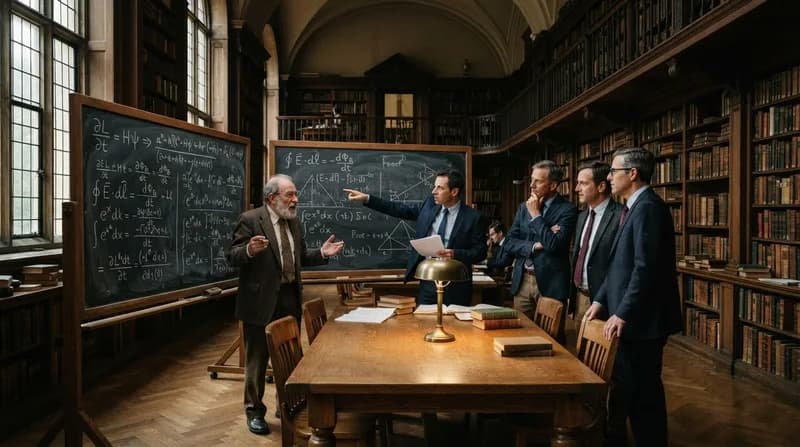
The bridge between artificial intelligence and formal mathematics is becoming a battlefield. Twenty-five of the world’s most distinguished mathematicians—all recipients of the Fields Medal, arguably the most prestigious honor in the field—have signed an open letter expressing deep concern over the trajectory of AI labs. Their argument is centered on a fundamental shift in how mathematical breakthroughs are achieved, communicated, and credited in an era where massive language models are increasingly used to race toward solutions for centuries-old challenges.
This friction reached a boiling point recently when NYU professor Tristan Buckmaster publicly questioned OpenAI’s methodology. Buckmaster alleged that the company pressured him to omit credit for a collaborator who happens to be employed by Anthropic, a primary competitor in the AI space. These concerns are compounded by suspicions that AI companies may be training their models on private or collaborative workflows, potentially weaponizing intellectual output to gain competitive advantages in a high-stakes, "winner-take-all" race to solve monumental mathematical problems.
The Erosion of Scientific Stewardship
The signatories of the open letter argue that the value of mathematics extends far beyond the final proof. They posit that the rigorous process of writing up, peer-reviewing, and building upon existing research is essential to the "intellectual super-structure" of human civilization. When AI models produce proofs in a sudden, rushed, and unverified manner, they risk bypassing the necessary human transmission chain that ensures these ideas are understood, integrated, and verified by the broader scientific community.
The cultural consequences of this shift are profound. As labs dump tens of millions of dollars into compute power to generate AI-assisted proofs, the incentive structure of mathematics shifts from collaborative discovery to corporate secrecy. The fear is that the traditional ethos of open research will be supplanted by a landscape of proprietary intellectual property, where AI-conceived ideas remain "lifeless" because they lack the human context and verification required for genuine academic progress.
Why It Matters
- Attribution and Integrity: The rush to claim breakthroughs may lead to the erasure of human collaborators, raising serious ethical questions regarding plagiarism and academic credit.
- Verification Crisis: AI-generated proofs that are announced without a formal, human-vetted write-up risk being inaccurate or unverifiable, undermining trust in the scientific process.
- Shift to Secrecy: If frontier AI labs can use superior compute to "out-research" the academic community, it may force independent mathematicians into a defensive, secretive stance, stifling innovation.
- A Warning for All Fields: The issues facing mathematicians today—automation, loss of context, and the corporate capture of creative workflows—are a harbinger for software engineers, scientists, and creative professionals across the board.
Implications for the Future of Research
The current tension is not merely a dispute over a single math problem; it represents a broader crisis in how society values creative work. If the "work around the work"—the process of mentoring students, debating theories, and cataloging findings—is discarded in favor of raw model output, the depth of human understanding could be compromised. The mathematicians’ warning serves as a sobering reminder that as we delegate more of our cognitive heavy lifting to AI, we must remain vigilant about what is being lost in the transition. As these models become more capable, the primary goal for researchers and policy makers must be to ensure that the human connection to discovery remains at the center of the technological transformation.