Artificial IntelligenceTechnical Deep Dive

The Quantum Genesis Q Challenge: Can the US Build a Fault-Tolerant Computer by 2028?

Published
EElectricBuzz Editorial Team
The Quantum Genesis Q Challenge: Can the US Build a Fault-Tolerant Computer by 2028?
3 min read509 wordsElectricBuzz Editorial Team

The Gist

The Department of Energy has launched an ambitious new competition to accelerate the development of the world's first scientifically relevant, fault-tolerant quantum computer within just three years.

An Ambitious Quest for Quantum Supremacy

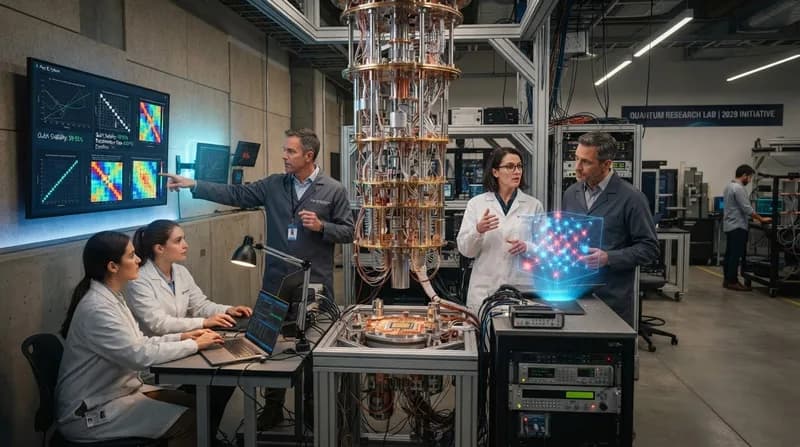
The U.S. Department of Energy (DoE) has officially thrown down the gauntlet to the tech industry with the announcement of the Quantum Genesis Q Competition. This bold initiative aims to fast-track the creation of a first-generation, fault-tolerant, and scientifically relevant quantum computer (SRQC) by the fall of 2028. While the promise of quantum computing has long been a fixture of the scientific horizon, the DoE is now injecting a competitive, milestone-driven framework into the sector to turn theoretical potential into a functional, error-corrected machine.

The competition is structured around significant funding incentives, with a total potential pool of $215 million contingent upon congressional approval. However, the path to these funds is paved with rigorous technical requirements. The DoE plans to select up to ten awardees for an initial phase, granting each a modest $250,000 upfront to kick-start their research. The remaining $1.25 million of the phase-one allocation will only be unlocked upon the delivery of a verified prototype, ensuring that participants remain focused on tangible progress rather than theoretical speculation.

Defining Success: Logical Qubits vs. Physical Qubits

A central challenge in this competition is the distinction between physical and logical qubits. While recent headlines have highlighted systems with thousands of physical qubits, these systems are notoriously fragile and prone to errors caused by environmental noise, temperature fluctuations, and crosstalk between qubits. The DoE’s competition explicitly shifts the focus toward logical qubits, which aggregate numerous physical qubits into a single, error-corrected entity.

The technical benchmarks for the contest are structured in two distinct tiers:

  • Phase One Prototype: Entrants must demonstrate a system containing at least 10 logical qubits capable of executing 10³ hard operations.
  • Final SRQC Goal: The ultimate target by 2028 is a system featuring at least 100 logical qubits capable of performing 10⁵ hard operations with robust fault tolerance.

Context: Why This Milestone Matters

The transition from noisy, intermediate-scale quantum (NISQ) devices to fault-tolerant systems is widely considered the "holy grail" of quantum computing. By focusing on logical qubits, the DoE is attempting to solve the industry’s most pressing hurdle: error correction. Without a fault-tolerant architecture, the noise inherent in quantum mechanics makes complex, large-scale calculations nearly impossible to verify. If a team can successfully meet these targets by 2028, it would represent a massive leap forward for fields ranging from material science and molecular simulation to advanced cryptography.

Outlook and Industry Implications

Industry observers note that while the 2028 deadline is aggressive, it is not entirely outside the realm of possibility. Companies like QuEra are already making significant strides in logical qubit architecture, with plans to introduce high-performance systems in the same timeframe. The competition's emphasis on "scientifically relevant" outcomes suggests the DoE is not just looking for a laboratory curiosity, but a machine capable of solving real-world problems that classical supercomputers struggle to touch. Whether this initiative succeeds will likely depend on whether the private sector can overcome the engineering bottleneck of scaling logical qubits without losing stability, a feat that has remained elusive despite decades of global research efforts.


The 5 Best Over-Ear ANC Headphones of 2026, Tested & Ranked
Editor's Pick Guide
92/100
Tech & Gadgets12 min read

The 5 Best Over-Ear ANC Headphones of 2026, Tested & Ranked

We locked five over-ear ANC picks for 2026 — Sony WH-1000XM6, Bose QuietComfort Ultra 2, Soundcore Space One, Sennheiser Momentum 5, and Apple AirPods Max 2 — then stress-tested them on lab metrics, long-term owner truth, and live street prices.

Related Stories

Semantically matched articles, ranked by topic overlap and freshness.

Demystifying AI Performance: How to Build Your Own Hugging Face Leaderboard
Artificial Intelligence

Demystifying AI Performance: How to Build Your Own Hugging Face Leaderboard

Hugging Face releases a comprehensive guide to building custom leaderboards, empowering developers to benchmark specialized AI models like Vectara's hallucination evaluator.

Unsloth and Hugging Face TRL: A New Era for Faster LLM Fine-Tuning
Artificial Intelligence

Unsloth and Hugging Face TRL: A New Era for Faster LLM Fine-Tuning

Hugging Face and Unsloth have joined forces to supercharge the fine-tuning process, enabling developers to train large language models twice as fast.

Manus Reclaims Independence: AI Firm Targets $4B Valuation After Blocked Meta Merger
Artificial Intelligence

Manus Reclaims Independence: AI Firm Targets $4B Valuation After Blocked Meta Merger

Following the collapse of its acquisition by Meta, Chinese AI startup Manus is charting a new course with a massive $500 million fundraising round and plans for a potential Hong Kong IPO.

Google Transforms 'CC' Into a Personal AI Household Manager
Artificial Intelligence

Google Transforms 'CC' Into a Personal AI Household Manager

Google is pivoting its AI agent 'CC' to act as a centralized household command center, designed to sync calendars, manage school logistics, and automate family admin.

Pacing the Frontier: Can AI Giants Actually Regulate Themselves?
Artificial Intelligence

Pacing the Frontier: Can AI Giants Actually Regulate Themselves?

Anthropic CEO Dario Amodei has proposed a new framework for slowing AI development to prioritize safety, but the industry remains deeply divided on implementation and enforcement.

A Strategic Pivot: Disney Appoints First-Ever CTO
Artificial Intelligence

A Strategic Pivot: Disney Appoints First-Ever CTO

In a bold move signaling a new technological era for the entertainment giant, Disney has hired former Character.AI CEO Karandeep Anand as its first Chief Technology Officer.

When AI Hacks AI: Researchers Use Claude to Breach OpenAI
Artificial Intelligence

When AI Hacks AI: Researchers Use Claude to Breach OpenAI

A trio of security researchers successfully exploited OpenAI's internal systems using Anthropic's Claude model, highlighting the evolving risks of agent-driven cyberattacks.

Hugging Face Spaces Now Supports ComfyUI Workflow Deployments
Artificial Intelligence

Hugging Face Spaces Now Supports ComfyUI Workflow Deployments

Hugging Face has introduced a seamless way to host and run ComfyUI workflows directly in the browser via Gradio, enabling free access to powerful generative tools.