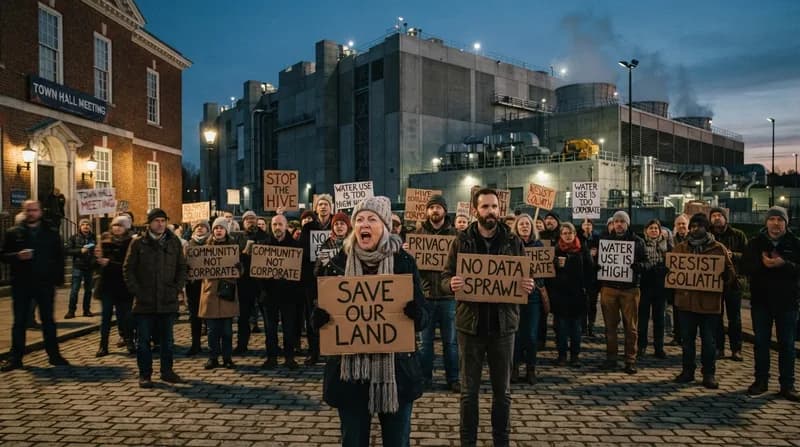
The Rise of the Data Center Backlash
For decades, the physical infrastructure supporting our digital lives remained largely invisible—a background hum that powered search engines and social media. However, as the demand for massive computational power required by generative AI skyrockets, that invisibility has shattered. Journalist Paris Marx, in their new book Hyperscale, argues that data centers have evolved from mundane utility buildings into a major political and environmental flashpoint, fueling a rare, bipartisan wave of community resistance across the globe.
This opposition is grounded in the tangible consequences of these facilities. Unlike the abstract nature of software or cloud services, a data center is a physical presence that commands massive amounts of electricity, consumes vast quantities of water for cooling, and creates a constant, piercing acoustic footprint. As these industrial-scale sites proliferate, they are forcing local communities to confront the direct costs of the tech industry’s expansion plans, often at the expense of their own power grid stability and water security.
The Anatomy of a Modern Data Center
Getting behind the scenes of a modern hyperscale data center is an exercise in extreme security. Access is rarely granted, and entry requires intense vetting, including pre-cleared identification. Once inside, the experience is notably anti-climactic yet overwhelming. Contrary to cinematic portrayals of high-tech, glowing laboratories, the reality is a utilitarian environment characterized by rows of server racks, blindingly high-security protocols, and a deafening, constant roar generated by industrial-grade cooling fans.
The physical environment inside these server halls is designed for thermal efficiency rather than human comfort. Without ear protection, the noise is piercing, and the climate is controlled by aggressive air conditioning systems pumping cold air directly into the heat-dense server cabinets. These facilities function as the literal, industrial engines of the modern economy, yet they are increasingly viewed as unsustainable burdens that prioritize corporate ambitions over the immediate quality of life of the surrounding population.
Why It Matters: Local Impact vs. Global Ambition
The controversy surrounding these facilities is rooted in the conflict between the tech industry’s "hyperscale" growth strategy and local resource constraints. In places like Dublin, Ireland, data centers began consuming over 20% of the national electricity supply, forcing regulators to impose strict grid-connection moratoriums. Similarly, in The Dalles, Oregon, and Santiago, Chile, disputes over water consumption have sparked legal battles and public outcry, as communities compete with tech giants for access to dwindling local resources.
- Energy Consumption: Scaling AI models requires massive electricity draws that threaten local grid reliability and hike prices for residents.
- Water Scarcity: Significant water volumes are required for cooling systems, often creating direct competition with agricultural or residential needs in drought-prone regions.
- Bipartisan Opposition: Data center expansion has bridged deep political divides, with figures across the ideological spectrum identifying the facilities as an encroachment on local sovereignty.
- Transparency Concerns: The historical reliance on NDAs and opaque deal-making between tech companies and local governments has only fueled public distrust.
The Broader Tech Manifestation
Marx posits that the data center movement is just one facet of a broader public rejection of the "physicality" of Big Tech. Whether it is the proliferation of surveillance cameras, the introduction of AR smart glasses, or the deployment of autonomous vehicles, the public is becoming increasingly attuned to how technology manifests in their physical surroundings. Unlike digital services, which can be ignored or deleted, these physical structures and devices represent a tangible intrusion. As these companies continue to push for massive infrastructure footprints to sustain their generative AI ambitions, the resistance is likely to move from a local nuisance to a systemic challenge that will fundamentally shape the future of tech regulation and corporate accountability.