Simulating the Invisible
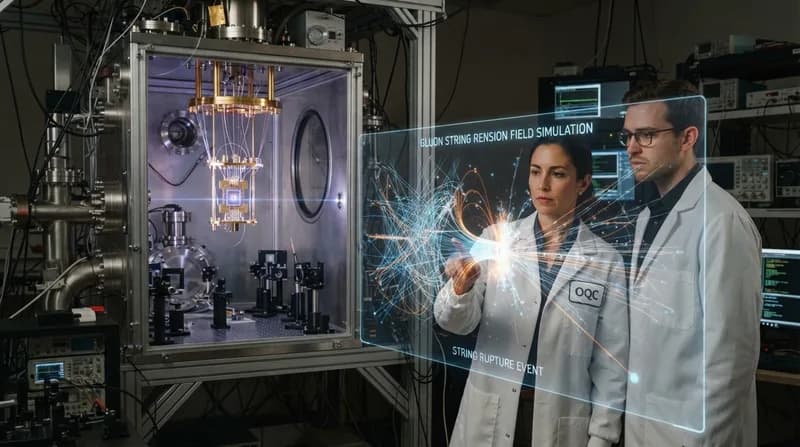
In a landmark achievement for computational physics, a team led by quantum pioneer Christopher Monroe at Duke University has successfully simulated the elusive process of gluon string breaking using a trapped-ion quantum device. This fundamental mechanism, which governs how quarks bind together to form hadrons like protons and neutrons, has long been difficult to study because quarks cannot be isolated in nature. When a quark is pulled away from its antiquark, the energy within the gluon field connecting them grows until it triggers the creation of a new pair, a process that is essentially the 'strong force' in action.
By utilizing a trapped-ion quantum computer, the researchers were able to create a controlled environment where these quantum chromodynamic (QCD) interactions could be modeled. Instead of relying on classical computing approximations, the team mapped the behavior of quarks onto 'domain walls'—specific regions where adjacent ions possess opposite spins. By adjusting an external magnetic field, they could simulate the increasing potential energy in the gluon field, effectively observing the transition where the system creates new particles, confirming the validity of quantum simulation for high-energy physics.
Challenging Theoretical Foundations
The implications of this experiment extend beyond simple validation; the findings actually suggest that the canonical theories of string breaking, originally proposed by Nobel laureate Julian Schwinger in 1951, require subtle but important revisions. The team observed that string breaking does not necessarily occur uniformly throughout the system. Instead, the process appears to be initiated at the edges of the gluon field, where coupling to the quantum vacuum lowers the energetic barrier for creating new matter, before the effect propagates toward the center.
Why it Matters
- Beyond Classical Limits: While current quantum systems are not yet outperforming supercomputers for these specific calculations, this demonstration proves that trapped-ion technology is a viable platform for probing gauge theories and fundamental physics that are inaccessible in real-world particle colliders.
- Refining Theory: The observation that string breaking begins at the edges indicates that our mathematical models of the strong interaction are incomplete, providing a roadmap for theoretical physicists to refine their understanding of how matter emerges from energy.
- Scalability: As researchers increase qubit counts and circuit depth, they anticipate moving beyond simple simulations to studying complex meson scattering experiments, potentially unlocking deeper mysteries of the quantum vacuum.
The Path Toward Quantum Supremacy in Physics
The success of the Duke University team adds a significant chapter to the ongoing global effort to use quantum hardware for scientific discovery. By achieving results similar to those obtained by researchers using neutral atoms and superconducting qubits, the team has reinforced the idea that diverse quantum computing architectures can converge on the same physical truths. This redundancy is vital for building confidence in quantum-based scientific modeling.
Looking ahead, the researchers are collaborating with theoretical partners at the University of Maryland to explore more complex configurations. The goal is to eventually simulate the inverse process—string formation during high-energy particle collisions. As quantum processors become more robust, they will transition from being experimental testbeds to essential tools for solving the most profound questions in subatomic physics, potentially revealing insights that no classical algorithm could ever compute.