ScienceTechnical Deep Dive

Perseverance Rover Uncovers Organic Carbon in Ancient Martian Rock

Published
EElectricBuzz Editorial Team
Perseverance Rover Uncovers Organic Carbon in Ancient Martian Rock
3 min read523 wordsElectricBuzz Editorial Team

The Gist

“NASA's Perseverance rover has identified complex organic matter just beneath the surface of Mars, offering fresh evidence that the Red Planet may have once harbored the essential ingredients for life.”

A Significant Discovery in the Bright Angel Formation

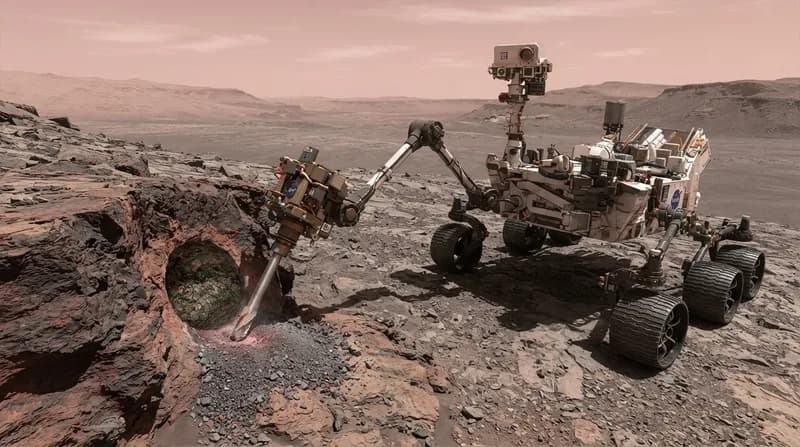
NASA's Perseverance rover has achieved a milestone in the ongoing quest to understand the geological history of Mars. By utilizing its advanced suite of instruments within the Jezero crater, the rover has confirmed the presence of macromolecular carbon (MMC) embedded in ancient mudstone formations known as the Bright Angel region. This finding is particularly notable because the material was detected only microns beneath the Martian surface—a location previously thought to be too harsh to preserve such delicate chemical compounds.

The discovery represents a critical advancement in planetary science. While the presence of organic carbon does not definitively prove that life once existed on Mars, it confirms that the building blocks necessary for biological processes were likely widespread. The detection of these interconnected carbon networks suggests that ancient Martian lakes and rivers may have been far more chemically active than previously assumed.

The Role of the SHERLOC Instrument

The identification of this carbon was made possible by the Scanning Habitable Environments with Raman & Luminescence for Organics & Chemicals (SHERLOC) instrument. Mounted on the robotic arm of the Perseverance rover, SHERLOC employs sophisticated Raman spectroscopy to analyze the mineralogical and chemical composition of Martian rock without requiring physical sampling that could compromise the integrity of the specimen.

By directing a laser at the target rock, researchers were able to map the distribution of carbon alongside various minerals, such as sulfates and carbonates. This spatial distribution provides a geological timeline, hinting that organic material may have been introduced to the sediment during at least two distinct periods in Mars' history. The ability to identify these compounds at such high resolution serves as a testament to the engineering prowess behind the Mars 2020 mission.

Understanding Survival in a Harsh Environment

One of the most intriguing aspects of this discovery is the depth at which the organic matter was found. Mars is subject to intense radiation and chemical oxidation, both of which are highly efficient at degrading organic molecules. Finding these compounds so close to the surface—thinner than the width of a sheet of paper—raises questions about the protective mechanisms at play.

Scientists hypothesize that the material may have been protected by the surrounding minerals, specifically clays or iron-rich Martian soils, which acted as a shield against the planet's volatile atmosphere. Furthermore, the inherent chemical stability of the specific macromolecular carbon detected might have allowed it to resist breakdown over billions of years. Unlocking the secret of how these compounds survived could dictate where future missions look for signs of ancient life.

Why it Matters

This discovery bridges a massive gap in our understanding of Martian habitability. By finding similar organic markers over 2,000 miles away from where the Curiosity rover previously identified organic compounds, researchers now have evidence that the chemistry associated with the foundations of life was not isolated to one spot, but potentially present across the entire planet. While current rovers lack the laboratory equipment required to distinguish between biological and non-biological origins of this carbon, the mission provides a clear roadmap for future sample-return efforts that will bring these rocks to Earth for high-precision analysis.


SPONSORED
The 5 Best Over-Ear ANC Headphones of 2026, Tested & Ranked
Editor's Pick Guide
92/100
Tech & Gadgets•12 min read

The 5 Best Over-Ear ANC Headphones of 2026, Tested & Ranked

We locked five over-ear ANC picks for 2026 — Sony WH-1000XM6, Bose QuietComfort Ultra 2, Soundcore Space One, Sennheiser Momentum 5, and Apple AirPods Max 2 — then stress-tested them on lab metrics, long-term owner truth, and live street prices.

Related Stories

Semantically matched articles, ranked by topic overlap and freshness.

Unlocking the Neural Mysteries of Dyscalculia: Why Some Children Struggle with Math
Science

Unlocking the Neural Mysteries of Dyscalculia: Why Some Children Struggle with Math

New Stanford research reveals that math learning difficulties may stem from brain-level challenges in cognitive flexibility and strategy management rather than a simple inability to calculate.

New Data Reveals Significant Drop in Infant Mortality Across England
Science

New Data Reveals Significant Drop in Infant Mortality Across England

New national health data shows a 16% reduction in infant mortality rates in some of England's most disadvantaged areas, driven by the expansion of targeted perinatal care bundles.

Avian Intellect: Why Crows Outpace Humans in Rapid Decision-Making
Science

Avian Intellect: Why Crows Outpace Humans in Rapid Decision-Making

New research reveals that crows process visual information and reach conclusions twice as fast as primates, challenging our understanding of brain architecture.

Mapping the Mind: New Atlas Decodes 8 Million Brain Cells
Science

Mapping the Mind: New Atlas Decodes 8 Million Brain Cells

Researchers at UC Irvine have unveiled a groundbreaking multiscale map of the human basal ganglia, shedding light on the cellular architecture of movement, habit, and motivation.

Magnetic Breakthrough Promises Ultra-Efficient Chips for Future AI
Science

Magnetic Breakthrough Promises Ultra-Efficient Chips for Future AI

Researchers at Brown University have conquered the 'dead layer' effect in multiferroic materials, paving the way for significantly more energy-efficient AI hardware.

Federal Funding Greenlit for Ibogaine Research in Veteran PTSD Studies
Science

Federal Funding Greenlit for Ibogaine Research in Veteran PTSD Studies

The U.S. government is investing $4.9 million to prepare for clinical trials of ibogaine, a controversial psychedelic aimed at addressing intractable PTSD.

American Cancer Society Issues Landmark Update to Prostate Cancer Screening Guidelines
Science

American Cancer Society Issues Landmark Update to Prostate Cancer Screening Guidelines

The American Cancer Society has released significant updates to its prostate cancer screening protocols, aiming to improve early detection rates and reduce mortality for high-risk populations.

NASA Launches $500,000 AMPERE Challenge to Revolutionize Space Propulsion
Science

NASA Launches $500,000 AMPERE Challenge to Revolutionize Space Propulsion

NASA is opening a new frontier in deep-space logistics by funding the next generation of mid-power Hall effect thrusters.