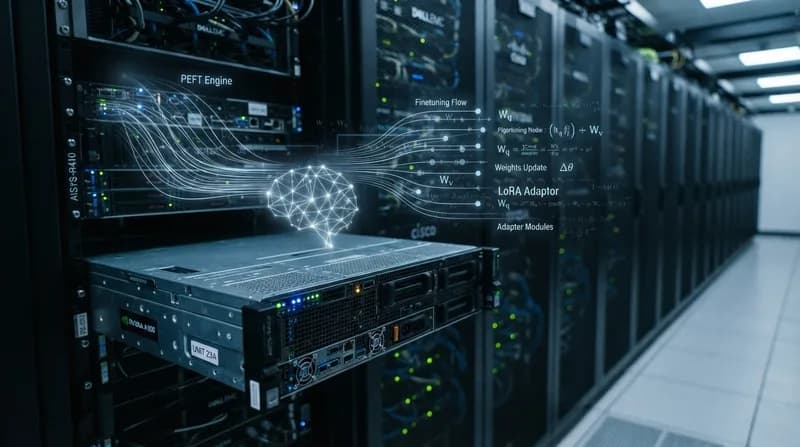
Revolutionizing LLM Efficiency
As Large Language Models (LLMs) continue to balloon in parameter counts, the cost and computational requirements for fine-tuning have become significant barriers to entry for many developers. Hugging Face is addressing this bottleneck with the PEFT (Parameter-Efficient Fine-Tuning) library. Instead of updating every single weight within a massive architecture, PEFT focuses on training only a small subset of additional parameters while keeping the pre-trained weights frozen.
This approach drastically reduces memory consumption and storage needs. By avoiding the need to store full copies of massive models for every custom application, PEFT empowers individual developers and smaller research teams to achieve state-of-the-art performance on hardware that would otherwise be insufficient for standard full-parameter fine-tuning.
Why It Matters
- Reduced Computational Overhead: Dramatically lowers GPU memory usage during the training phase.
- Storage Efficiency: Only the lightweight adapters need to be saved, rather than multi-gigabyte base models.
- Accessibility: Enables the adaptation of powerful foundation models, like those from the BigScience project, on consumer-grade hardware.
- Seamless Integration: Designed to work directly with the existing Hugging Face ecosystem, including the Transformers and Accelerate libraries.
The Future of Custom AI
The implications for the AI ecosystem are profound. By shifting the paradigm toward parameter-efficient methods, Hugging Face is effectively democratizing access to specialized AI. Organizations can now leverage high-performance models like the mt0-large variant for domain-specific tasks without the prohibitive costs associated with full-scale infrastructure. As the industry moves away from brute-force training methods, PEFT represents a critical step toward sustainable, scalable, and highly performant AI development, ensuring that innovation remains possible even when high-end computing resources are limited.