Revolutionizing Local AI on Apple Silicon
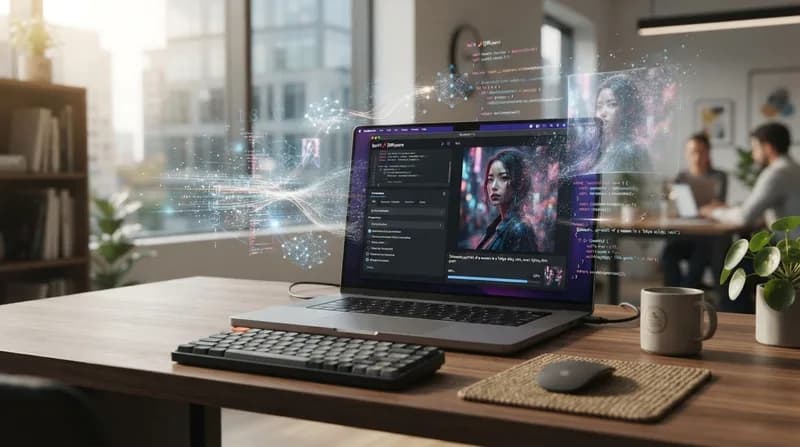
Hugging Face has taken a significant step forward in making advanced generative AI accessible to the everyday user with the release of Swift 🧨Diffusers version 1.1. Designed specifically for macOS, this native application leverages the power of Apple’s Core ML framework to run state-of-the-art text-to-image models directly on your hardware. By moving away from Python-based PyTorch environments and toward a native Swift implementation, the application offers a seamless, desktop-integrated experience for anyone looking to generate AI art without the friction of command-line interfaces or server-side dependencies.
The app is built to be a true "Mac citizen," following Apple’s design language and providing a polished interface that feels intuitive. Perhaps most importantly, it addresses privacy concerns head-on: because the generation happens entirely on your local machine, your prompts and generated imagery never leave your computer. This eliminates the need for expensive API credits or waiting in long cloud-service queues, putting the creative power of Stable Diffusion directly into the user’s hands.
The Power of Core ML Optimization
The core advantage of the Swift 🧨Diffusers architecture lies in its use of Core ML rather than traditional PyTorch implementations. While PyTorch on macOS often relies on the MPS accelerator, it lacks access to the full breadth of Apple’s specialized hardware. Core ML, by contrast, dynamically routes model workloads across the CPU, GPU, and the powerful Neural Engine (ANE) simultaneously. This optimization allows the app to extract every ounce of performance from Apple Silicon, making high-fidelity image generation significantly faster than previous software-first approaches.
Performance Breakdown
- Automatic Optimization: Version 1.1 includes heuristics that automatically select the best hardware acceleration path for your specific Mac configuration.
- Hardware Sensitivity: Benchmark data shows that performance scaling is highly dependent on chip architecture. For example, standard M1 chips see massive speed boosts using the Neural Engine, while the M1 Max benefits disproportionately from its superior GPU core count.
- Efficiency Gains: Depending on the specific Mac hardware, users can expect generation speeds up to twice as fast as previous iterations, narrowing the gap between local generation and cloud-based performance.
Refined Experience and Future Roadmap
Beyond raw performance, the 1.1 update introduces meaningful quality-of-life features that cater to both hobbyists and power users. New additions include refined model download indicators, a dedicated shortcut for reusing generation seeds to facilitate iteration, and adjustable guidance scales. The team has also simplified the interface to ensure that even non-technical users can navigate complex generation settings without frustration.
Looking ahead, the project is set to expand its reach. The development team has identified several key areas for future growth, including expanding support for the wide array of fine-tuned models available on the Hugging Face Hub and bringing the technology to iOS and iPadOS. Furthermore, by keeping the project fully open source, Hugging Face is inviting the broader developer community to contribute, essentially turning the app into a collaborative sandbox for advancing on-device AI efficiency.
Why it Matters
As the AI landscape pivots toward high-compute requirements, local execution on edge hardware like Macs remains the gold standard for user privacy and cost efficiency. By bridging the gap between cutting-edge research models and consumer-friendly native software, Hugging Face is demonstrating that powerful generative AI doesn't necessarily require a massive server farm—sometimes, it just needs well-optimized code and the right hardware-software synergy.